 on Facebook, Twitter +53 other..
காணொளி: ஈழத்தில் தமிழர் நிலங்கள் வன்பறிப்பு
VIDEO: Sinhala colonisation of Tamils' land
SRi Lanka is hiding War Crime
The sinhala government has been extremely successful in manipulating our actions for some time now. We have been put on a defensive footing trying to refute its claims and propaganda relating to the state of Tamils in the land, IDPs' settlement and the treatment of some 14000 youth in incarceration, not to mention its vast campaign to restore tourism.
and one tourist misled by the government and telling no problem but he is in Colombo (Capital)
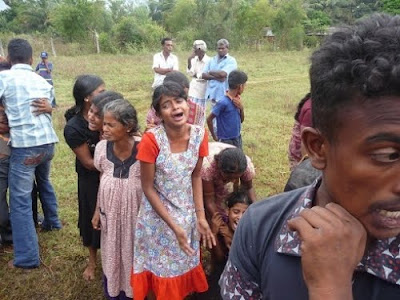
Six months ago in Sri Lanka, as the last bastion of the Tamil Tigers fell, tens of thousands of civilians who had fled the fighting were detained in refugee camps. Now the Sri Lankan army has given them permission to return home. We went to meet these refugees who have lost everything
.

"ஒன்றே குலம்; ஒருவனே தேவன்" – ஆசான் திருமூலர். நீதியில்லாதவனே சாதியை வகுத்திட்டான்; நெறிகெட்ட சாதிமுறையை ஒழிப்போம் வாரீர்.
Wednesday, 31 March 2010

வடக்கு கிழக்கு இணைப்பு என்பது மகிந்தவினது கொப்பனது சொத்தல்ல : இரா. சம்பந்தன்
 வடக்கு கிழக்கை இணைக்கமாட்டேன் என மகிந்த ராஜபக்ச கூறுகிறார். அது அவருடைய கொப்பனது சொத்தல்ல. அது எங்களுடையது என்பதை புரிந்துகொள்ளவேண்டும் என தமிழ் தேசிய கூட்டமைப்பின் திருமலை முதன்மை வேட்பாளர் இரா. சம்பந்தன் தெரிவித்துள்ளார்.
திகாமடுல்ல (அம்பாறை) தேர்தல் மாவட்டத்தின் காரைதீவில் நடைபெற்ற தேர்தல் பரப்புரை நிகழ்வில் கலந்துகொண்டு உரையாற்றும்போதே மேற்கண்டவாறு கூறினார்.
காரைதீவு பிரதேசசபை தவிசாளர் என். ஜீவராசா தலைமையில் நடைபெற்ற இப்பரப்புரைக்கூட்டம் நடைபெற்றது.
அங்கு உரையாற்றிய இரா.சம்பந்தன் மேலும் தெரிவித்துள்ளதாவது
1977 ஆம் ஆண்டு எமது திருமலை மாவட்டத்தின் வடபுறத்தில் நான் நாடாளுமன்ற உறுப்பினராக இருந்தபோத ஒரு வீட்டுத்திட்டத்தை அமைத்தோம்.
அந்த வீட்டுத்தோட்ட கிராமத்திற்கு நாம் இட்ட பெயர் ”விபுலானந்த கிராமம்” என்பதாகும். அவ்வாறு முத்தமிழ் வித்தகர் எனப்போற்றப்படும் விபுலானந்தர் பிறந்தமண்ணில் இன்று நான் பேசக் கிடைத்ததையிட்டு மகிழ்வடைகின்றேன்.
நாம் அடிமையாக வாழமாட்டோம். உரிமையுடன் வாழவேண்டும் என்று மிக உறுதியாக இருக்கலாம். இதுவே நம் மத்தியிலுள்ள பெரும் சவாலாகும்.
இன்று ஒரு பெரும் சவாலை நாம் எதிர்நோக்கியுள்ளோம். காரணம் 30 ஆண்டு காலமாக யுத்தம் நாட்டில் நடைபெற்றது. தந்தை செல்வாவின் கோரிக்கையின் அடிப்படையில் சமாதானமாக இனப்பிரச்சனை தீர்த்துக் கொள்ளப்படாததால் எமது மக்கள் மீது வன்முறைகள் கட்டவிழ்த்துவிடப்பட்டதன் நிமித்தம் நமது இளைஞர்கள் ஆயுதமேந்திப் போராடும் நிலைக்கு தள்ளப்பட்டனர்.
அந்த ஆயுதபோராட்டம் முப்பது ஆண்டு காலமாக நடைபெற்றது. எமது போராளிகள் பல சாதனைகளைப் படைத்தார்கள். இது எல்லோருக்கும் அறிந்த விடயம்.
வடக்கு கிழக்கு பிராந்தியத்தில் கணிசமானளவு பிரதேசம் அவர்களுடைய பொறுப்பிலிருந்தது. இன்று அது முடிவுக்கு வந்துள்ளது. ஏனைய நாடுகளின் உதவியுடன் போரை முடிவுக்கு கொண்டுவந்தது அரசு. தற்போது அந்த இயக்கம் எம்மத்தியில் இல்லை என கூறிவருகின்றது.
ஆனால் நாம் ஒன்றை மட்டும் மறந்துவிடமுடியாது. அந்த ஆயுதமேந்திய இயக்கம் நடத்திய போராட்டத்தின் நிமித்தமே எமது போராட்டம் சர்வதேச அரங்கில் முன்வரிசையில் இடம்பெற்றிருக்கிறது. இதை நாம் மறந்துவிடக்கூடாது. இந்தச் சூழ்நிலையில்தான் தற்பொழுது பொதுத்தேர்தல் நடைபெறுகிறது.
தற்பொழுது நம் மத்தியில் ஆயுத இயக்கமுமில்லை. ஆயுத போராட்டமுமில்லை. முதன்முறையாக நீண்ட காலத்தின் பின் ஒரு பொதுத்தேர்தல் புதிய சூழலில் நடைபெறுகின்றது. இன்று சர்வதேச சமூகம் இந்த தேர்தல் முடிவுகளை மிக உன்னிப்பாக பார்த்துக்கொண்டிருக்கின்றது. தமிழ் மக்களை எவ்வித முடிவை எடுக்கப்போகின்றார்கள் என அது காத்துக்கொண்டிருக்கின்றது.
தமிழ் மக்கள் அடிபணிந்த நாட்டின் இரண்டாம்தரப் பிரஜைகளாக வாழச் சம்மதம் தெரிவிக்கப்போகின்றார்களா? அல்லது தமிழ் மக்கள் இலங்கை தமிழரசு கட்சி – தமிழ் தேசிய கூட்டமைப்பினால் தேர்தல் விஞ்ஞாபனத்தில் வகுக்கப்பட்ட கொள்கையின் அடிப்படையில் வாக்களித்து தாம் ஒரு பெரும் தேசிய இனம், சரித்திர ரீதியாக வடக்கு கிழக்கில் வாழ்ந்து அது எமது தாயகம் எமக்கு சுயநிர்ணய உரிமை உண்டு என முடிவெடுக்கப்போகின்றார்களா? என்பதை சர்வதேச சமூகம் உன்னிப்பாக பார்த்துக்கொண்டிருக்கின்றது.
இதுவே தமிழ் மக்கள் எதிர்நோக்கியுள்ள சவாலாகும். - என தெரிவித்தார்.
Tuesday, 30 March 2010
'ஈழம்' என்ற சொல்லின் வரலாறு
2000 வருடங்களுக்கு முன்னரே தமிழர் ஏடுகளில் பாவனையிலிருந்த சொல் 'ஈழம்'.
The meaning of word 'Eelam' and it's usage in Tamil language well over 2000 years ago.
Eelam/Eezham etymology
Over two thousand years Eezham was in continued use without any change in its form in Tamil to denote the entire island called Sri Lanka today. The strong possibility is that the identities He’la and E’lu derived from Eezham. The three early names for the island, Thampa-pa’n’ni, Eezham and Seeha’la, the first one in Prakrit and the other two in Dravidian, are perhaps generically related to one another in meaning. They are geographical and descriptive of the landscape and its metallurgical potentialities, the column further says. A re-appraisal at the end of the column on the 2000 years-old Thirupparangkun'ram inscription of a person of migrant lineage from Eezham to Tamil Nadu, traces the connections of his personal name to Sinhala Pol and old Tamil Pul, both Dravidian, meaning coconut.
Name of the island called Sri Lanka today. In this sense it is found written in Tamil literature and Tamil Brahmi inscription dating back to the dawn of the Common Era (1st century BCE / 1st century CE); Eezham: Name of the country equated with Chingka’lam and another meaning given is gold (Tamil lexicons Cheanthan Thivaakaram of 8th century CE and Pingkalam of 10th century CE, Dravidian Etymological Dictionary 550); An additional meaning toddy is given by Choodaama’ni lexicon of 13th century CE; Eezhak-kaasu: Gold coin (comes in Tamil inscriptions dating from 912 CE); Eezha-vi’lakku: A kind of lamp made of Eezham alloy of metal or in the style of Eezham (Comes in Tamil inscriptions dating from 808 CE; Illama: A vein of metal (Sinhala, Clough’s Dictionary); Eezhavar: Name of a community that was climbing coconut and Palmyra palms (comes in Tamil inscriptions dating from 789 CE). The community found in Kerala today traces its origins to the island of Eezham; Heḷa-divi, Heḷa-ṭuva, Heḷa: The He'la Island (Sigiri graffiti, c.8-9th century CE, Dhampiyaa aṭuvaa gæṭapadaya, Sinhala literature, 10th century CE, Clough’s Dictionary); Heḷa-basa, Heḷu: The language of He'la; Dhampiyaa aṭuvaa gæṭapadaya, Sinhala literature, 10th century CE, equated with E'lu or ancient language of Ceylon (Clough’s Sinhala Dictionary); Eḷu: The country of E'lu as in the title of the Sinhala literature Eḷu Bōdhi Vamsa. Also language in later usages; Eḷuwa: The ancient Sinhalese language (Clough’s Sinhala Dictionary); E’lu-dhoo-karaa: (Eḷu dū karā): The land / coast / border of the E’lu Island. The traditional way Maldivians called today’s island of Sri Lanka in their literature and speech (Dhivehi Bas Foi, Maldivian Dictionary).
Among all the names that are currently in use for the island of Sri Lanka, Eezham seems to be the oldest one simultaneously attested by literature as well as epigraphy.
 Eezham, clearly spelt with the retroflex Ḻ (ZH) peculiar to Tamil, Malayalam and Old Kannada / Telugu, is found in Changkam literature (Paddinappaalai) and in the Thirupparangkun’ram Tamil Brahmi inscription dateable to the dawn of the Common Era, if not earlier.
The writer’s re-appraisal on the interpretation of Thirupparangkun’ram inscription is given at the end of this column.
It is a well-established fact that at least over two thousand years Eezham was in continued use without any change in its form in Tamil usage to denote the entire island.
Another name Tamba-pa’n’ni in Prakrit, so far the earliest definitely dateable name for the island, found in Asoka’s inscription of 3rd century BCE and in Greek records became obsolete later.
The names Seeha’la, Saimha’la, Sinha’la etc, which are yet another set of terms most probably of Dravidian origin and became Ceylon eventually, are two or more centuries late in their epigraphical appearance compared to Eezham.
 If a term Chaiy-a’lan found in a Tamil Brahmi inscription of 1st century CE could be accepted as meaning a person from Chaiy-a’lam and this place is nothing but Seeha’la of the Prakrit inscription of 2nd-3rd century CE, then the origins of the above set of terms could go on par with Eezham in antiquity. (See column on Seeha’la / Chingka’lam / Ceylon)
Such parallel occurrences around the dawn and early centuries of the Common Era make it very clear that Eezham and Seeha’la were parallel names for the island and they are not derivates of one into the other in their formulations.
Some early writers have surmised that the Sanskrit name Saimha’la became Seeha’la in Prakrit and this in turn has become Se’la, He’la, E’lu etc, and Eezham was derived from E’lu.
Even the authors of Dravidian Etymological Dictionary tend to infer this origin for Eezham (DED 550, note the direction of the arrow mark in the entry in the dictionary).
Such etymological conclusions stemming from norms that Sanskrit is always older than Prakrit and Sinhala is an ethnic name of protohistoric origins, do not find support in objective epigraphical or literary evidences and in their chronological order.
Whether the Dravidian term See-a’la / Chai-a’lam (red tract of land) was Prakritised and then Sanskritised or vice versa is the question. If we go by inscriptions it should be the former.
The names Siele, Sele for the island appear for the first time in a Greek work of 6th century CE. The form He’la appears for the first time as an adjective for the geographical identity of the island in 8th century CE Sigiri Graffiti and as an adjective for the name of the language in a 10th century CE Sinhala literature. The form E’lu comes afterwards.
There is no logic in saying that the 2000-years-old word Eezham came form terms that appeared 1000 years later.
On the contrary, the stronger possibility is for He’la and E’lu to be derivates of Eezham.
The initial S / H in Se’la or He’la commonly occurs in Prakritising / Sanskritising Dravidian words, just like the initial addition of A or I or U in Tamilising Sanskrit / Prakrit words.
Also note how the retroflex Ḻ (ZH) is retained in He’la and E’lu as palatal ‘L, compared to alveolar L in Sele and in today’s spelling of Sinhala.
K. Indrapala traces another cognate of Eezham i.e., I’la in the Brahmi inscriptions of Sri Lanka and in Mahavamsa. (The Evolution of an Ethnic Identity, 2006, pp 144-145.) The evidences are weak but he makes an interesting point by showing how I’la-Naga of Mahavamsa became E’lun-Na in later literature and thus tracing the development of the word E’lu from I’la.
Coming to the meaning of the word Eezham, the word was clearly used in a geographical sense in Paddinappaalai. In the Thirupparangkun’ram inscription even though the word is associated with migrant identity it doesn’t go against understanding the word in a geographical sense that the person or his clan had come from the geographical space called Eezham.
Lexicons equate Eezham with Chingka’lam another geographical identity and at the same time give two more meanings, gold and toddy.
Much significance is attached to the omission of the meaning toddy in the earlier lexicons Thivaakaram and Pingkalam and its inclusion in the later lexicon Choodaama’ni. This excludes the possibility of toddy or coconut being the original meaning for the name Eezham. Obviously the meaning toddy got included in the later lexicon because of the specialisation of the migrant community from Eezham in the produce of coconut palm, especially toddy, for centuries.
The meaning gold given in the early Tamil lexicons needs closer scrutiny to get a cue for the origin of the name Eezham. There is another related Tamil word Eekai that stood for gold in the Changkam literature. Yet another related word Eeyam originally meant a variety of metals.
It should be noted here that in Tamil tradition a word Pon for gold meant five metals, gold, silver, copper, iron and lead as found in usages such as Aim-pon – five varieties of gold. Old lexicons also attest to such an idea about gold (Pingkalam, 10:871).
The island of Eezham was well known for metallic ores since distant past. Iron, copper and graphite – three of the five-gold were found in the island.
There is a reference in later literature of the popularity of Eezhaththu-Irumpu (Iron from Eezham). We do not know the antiquity of this nomenclature but a kind of sword called Eeli in both Sanskrit and Prakrit could probably be of Eezham origins.
Interestingly, Sinhala vocabulary has retained a term Illama for a vein of metal.
Medieval Tamil inscriptions, apart from coming out with a number of references to Eezhak-kaasu (a gold coin) also let us know about a kind of metal lamp called Eezha vi’lakku, Eezha-nilai vilakku etc.
We do not know what was special about this lamp; whether it was an import or recognition of a style, but there is a strong possibility that the reference was for the metal or metal alloy.
Eezham was probably the Tamil way of naming the land of metal ores just like the Sanskrit tradition of naming some of the Southeast Asian countries as Swrna-dvipa (Island of Gold) and Swarna-bhumi (Land of Gold).
This etymology for the word Eezham tally well with the other early names for the island, i.e., Tamba-pa’n’ni (the copper-coloured land) and See-a’la (the red tract of land), which are obvious references to the iron-rich red earth of the island.
Ample archaeological evidences attest to the flourishing iron industry in the length and breadth of the island in the megalithic protohistoric times and in the early historic times, when the island names discussed above probably originated
All the three identities, Tamba-pa’n’ni, Eezham and Seeha’la, the first one in Prakrit and the other two in Dravidian, are perhaps generically related to one another in meaning. They are geographical and descriptive of the landscape of the island and its metallurgical potentialities.
Lanka, another name for the island, considered to be older than the ones discussed above because of its Austro Asiatic origins, belongs to a different genre and will be taken up for a separate study in a subsequent column.
A list of original references to the terms and their chronology is given below, followed by a re-appraisal of the Thirupparangkun’ram inscription, for those who wish to pursue the investigation further:
Geographical Meaning:
Eezhaththu-u’navu: ஈழத்து உணவு: Food from Eezham (arriving in shipment to Kaavirippoom-paddinam); Changkam Diction, Paddinappaalai, c. 1st century CE.
Izha Kudumpikan / Eezha Kudumpikan: ஈழ குடும்பிகன்: Householder from Eezham / of the clan of Eezham; Thirupparangkun’ram Tamil Brahmi inscription, c. 1st century BCE / CE
Eezhaththup-Poothan Theavanaar, Mathurai Eezhaththup Poothan Theavanaar: ஈழத்துப் பூதன் தேவனார், மதுரை ஈழத்துப் பூதன் தேவனார்: The poet coming from Eezham / the poet hailing from Eezham but settled in Mathurai; One of the Changkam poets whose poems are found in Akanaanooru, Ku’runthokai and Natti’nai – early layer of Changkam literature dateable to centuries before the Common Era. But the compilation of the works giving his name is dated to c. 5th century CE.
Eezham Chingka’lam: "ஈழம் சிங்களம்": Eezham is geographically equated to Chingka’lam in this verse found in old lexicons; Tamil lexicons, Cheanthan Thivaakaram (8th century CE); Pinkalam (10th century CE) and Choodaama’ni (13th century CE)
Ilangkai Eezhaththu: இலங்கை ஈழத்து: Eezham that is Ilangkai or Eezham that is in Ilangkai; Eezham is geographically equated with Ilangkai; Perungkathai / Kongkuvea’l Maakkathai, Jaina Tamil literature of 10th century CE.
Eezham: ஈழம்: Used in geographical sense; Tamil inscription 905 CE, (TASSI 1962-65 p 1-31, also Glossary of Tamil Inscriptions)
Eezhaththaraiyan: ஈழத்தரையன்: The king of Eezham; Tamil inscription 919 CE, (SII iii p99, also GTI).
Eezha-mandalam: ஈழ மன்டலம்: The geographical region of Eezham (as part of the Chola Empire); Tamil inscription 1012 CE (SII vii p863, also GTI).
Eezhap-padai: ஈழப் படை: The army of Eezham; Tamil inscription 1168 CE (SII vii 456, also GTI).
Eezham: ஈழம்: In Tamil literature and Epigraphy, this is the word that is found used with the longest continuity over two thousand years to mean the entire island. Tamil literature that arose in the island as well as inscriptions such as the one found at Fort Hammenhiel, Kayts (1017 CE) also have used the term. Somewhat a modern sense of national identity could be traced in the use of the word in Pa’raa’lai Vinaayakar Pa’l’lu, an Eezham Tamil literature of the Dutch period, in which the senior wife of the cultivation worker while challenging the junior who had come from the Chola country would assert “ Eezham is our country” (Eezha ma’ndala naadengka’l naadea / ஈழ மண்டல நாடெங்கள் நாடே).
Meaning Gold / Coin / Metal:
Eezham: ஈழம்: Gold; Tamil lexicons Cheanthan Thivaakaram (8th century CE), Pingkalam (10th century CE), Choodaama’ni (13th century CE), Dravidian Etymological Dictionary 550
Eezhak-kaasu: ஈழக் காசு: Gold coin / the money of Eezham; Tamil inscription 912 CE (MCCM viii p144-09, also GTI)
Eezhak-kazhagnchu: ஈழக் கழஞ்சு: Gold coin / Gold coin of Eezham; Tamil inscription 950 CE (TASSI 1962-65 p32-52, also GTI)
Eezhak-karung kaasu: ஈழக் கருங் காசு:A kind of gold coinage / a kind of gold coinage from Eezham; Tamil inscription 960 CE (SII xiii p84, also GTI)
Eezhang-kaasu: ஈழங் காசு: Gold coin / the money of Eezham; Tamil inscription 1189 CE (CHEN xxviii p 144, also GTI)
Eekai: ஈகை: Gold; Tamil, Changkam Diction, dateable to the dawn of the Common Era (Puranaanoo’ru 99:5, 353:3, Ku’rignchippaaddu 126, Malaipadukadaam 72), Tamil lexicon, 10th century CE (Pingkalam 10:155)
Eeyam: ஈயம்: Lead, originally a common name for several metals, lead, graphite, copper etc. (Lexicons, Thivaakaram, 6:26, Pingkalam10:509, Choodaama’ni 11:299); One of the five metals, gold, silver, copper, iron and lead. All five of them were often called Aim-pon – the five kinds of gold. The usage of ‘five kinds of gold’ is also attested to by one of the lexicons (Pingkalam 10:871). The island of Sri Lanka is a well-known source for iron, copper and graphite; Eeyan, Eeyam, Eeyama: Lead (Sinhala)
Illama: A vein metal (Sinhala)
Meaning an identifiable community engaged in tapping toddy or climbing palmyra and coconut palms to get their produce.
Eezhap-poochchi: ஈழப் பூச்சி: A kind of tax on the community of Eezhavar who were tapping toddy, Tamil inscription 750 CE, (EI vol 8, also GTI)
Eezham-poodchi: ஈழம் பூட்சி: A kind of tax levied from the community of Eezhavar tapping toddy; Tamil inscription 789 CE (SII ii p99, also GTI)
Eezhavar: ஈழவர்: The name of the community indicated as those who climb coconut palms and palmyra palms; Tamil inscription 789 CE (SII ii p99, also GTI)
Eezhavar, Eezhak-kaiyar: ஈழவர், ஈழக் கையர்: The community of Eezhavar and those who belong to the code of conduct of the guild of Eezhavar; (Tamil inscription 849 CE (TAS ii p 67-68, also GTI). One shade of meaning for the word Kai in old Tamil is code of conduct. The word was used in this sense in the names of guild-based identities such as Kaikkoa’lar and in the names of identities such as Valang-kai, Idang-kai etc.
Eezhach-chaan’raan: ஈழச் சான்றான்: The one who draws toddy belonging to the Eezham community; Tamil inscription 929 CE (SII iv 533, also GTI)
Eezhak-kula-theepan: ஈழக் குல தீபன்: The light of the community of Eezhavar. Reference to a Saiva saint Eanaathi-naatha-naayanaar, Nampiyaa’ndaar Nampi, Thiruththo’ndar Thiruvanthaathi, verse 10, 10th century CE
Eezhavan: ஈழவன்: The community tapping toddy mentioned along with Kollan (black smith), Va’n’naan (washerman), Pa’rampan (leather workers / a hill tribe) and Pa’raiyan (drummers); Tamil inscription 1000 CE (EI xxxiii p 33, also GTI)
Eezhap-poodchi: ஈழப் பூட்சி: A kind of tax levied on the community of Eezhavar who were tapping toddy; Tamil inscription 1008 CE (EI xxii p 34, also GTI)
Eezhach-cheari: ஈழச் சேரி: The settlement of Eezhavar; Tamil inscription 1014 CE (SII ii p 4, also GTI)
Eezham: ஈழம்: Toddy; Tamil lexicon (Choodaama’ni 13th century CE)
Eezhavar: ஈழவர்: Today this is the name of a caste associated with drawing toddy in southern Kerala. Migration is remembered in the legends and folklore of this community, which traces its origins to the island of Eezham.
Eedi, Eedigaa, Eedigitti: ஈடி, ஈடிகா, ஈடிகித்தி: Toddy, toddy-tapping man, toddy-tapping woman respectively (Kannada, note the ZH / D interchange, DED 549, 550)
Eedigaa, Ee’ndra, Ee’ndradi: ஈடிகா, ஈண்ட்ரா, ஈண்ட்ரதி: Toddy, man and woman of the toddy-tapping community (Telugu, note the ZH / D interchange, DED 549, 550).
Lamp made in the style of the country of Eezham or lamp made of a particular alloy of metal
Eezha Vi’lakku: ஈழ விளக்கு: The lamp of Eezham; Tamil inscription 808 CE (EI vi p29, also GTI)
Eezha Nilai-vi’lakku: ஈழ நிலை விளக்கு: Stationary lamp of Eezham; Tamil inscription 923 CE (SII xix 397, also GTI)
Eezhach-chiyal vi'lakku, Eezha-achchiyal vi'lakku: ஈழச்சியல் விளக்கு, ஈழ அச்சியல் விளக்கு: A kind of Eezham-lamp; Tamil inscription 1009 CE (SII v p521)
Eezhap-parisu: ஈழப் பரிசு: A lamp made in the Eezham way – an eight sided or eight angled lamp made of brass as we come to know from the ionscription; Tamil inscription 1014 CE (SII ii p36, also GTI)
GTI: Glossary of Tamil Inscriptions (In Tamil), Santi Sadhana, Chennai, 2002
EI: Epigraphia Indica
SII: South Indian Inscriptions
TASSI: Transactions of the Archaeological Society of South India
TAS: Travancore Archaeological Series
CHEN: Chenthamizh, Journal of Madurai Thamizh Changam
MCCM: Madras Christian College Magazine
Cognates in Sinhala:
I'la-barata: (Iḷa-barata) Whether this phrase found in a Brahmi inscription of Sri Lanka means a person of Parathavar community of Eezham or whether the phrase as one word means a place name as the word in the inscription is followed by a locative case ‘hi’ (Iḷabaratahi) are debatable (Brahmi inscriptions of Ceylon, Paranavitana, 1970, No 94; Seneviratne. S., 1985 and Indrapala K., 2006)
I'la-naaga: (Iḷa-nāga) Name of a 1st century CE ruler of the island found mentioned in Mahavamsa compiled in 5th century CE. Sinhala chronicles of the later period rendering the name as Eḷun-Nā may imply that I'la of the early centuries and E'lu of the later centuries were cognates. However, whether the word I'la in this case means Naga of I'la country / identity or whether it was an adjective to mean younger or junior is debatable (Indrapala K., 2006)
He'la-divi: (Heḷa-divi) The ‘He'la island’; (Sigiri graffiti, c.8-9th century CE)
He'la-tuva: (Heḷa-ṭuva) The He'la island; Dhampiyaa aṭuvaa gæṭapadaya, 10th cenury CE Sinhala literature (K. Indrapala, 2006 p 369)
He'la-basa: (Heḷa-basa) The language of He'la; Dhampiyaa aṭuvaa gæṭapadaya, 10th cenury CE Sinhala literature (K. Indrapala, 2006 p 369), Elu or ancient language of Ceylon (Clough’s Sinhala Dictionary)
He'lu: (Heḷu) The country or language of He'lu; Dhampiyaa aṭuvaa gæṭapadaya, 10th cenury CE Sinhala literature (K. Indrapala, 2006 p 369)
He'la: (Heḷa) The ancient name of Ceylon; (Clough’s Sinhala Dictionary traces the origin of the word to Sihala > Seela > Sela > Hela)
E'lu: (Eḷu) The country of E'lu as in the title of the Sinhala literature Eḷu Bōdhi Vamsa. Also language in later usages
E'luwa: (Eḷuva) The ancient Sinhalese language (Clough’s Sinhala Dictionary)
Cognate in Maldivian / Dhivehi:
E’lu-dhoo-karaa: Eḷu-dū-karā: (in Maldivian transcription, Elhu dhoo karaa): This is the traditional Maldivian way found in literature and usage to refer to the island called Sri Lanka today. Any foreign country is referred to as Karaa in Maldivian (Karai : coast, border etc in Tamil). In Tamil the phrase literally means ‘the coast of the island of E’lu / Eezham’ (E’lu: Eezham; Dhoo: island; Karaa: coast / border / land)
 This inscription in Tamil language and Tamil Brahmi characters, palaeographically dateable to the dawn of the Common Era, appears in one line on the ledge above a row of stone beds made for Jaina monks in a cave in Thirupparangkun’ram hill near Madurai in Tamil Nadu.
The inscription was first published in Annual Report of Epigraphy of the Archaeological Survey of India, 1908 and 1911-12.
The latest study of the inscription can be found in Iravatam Mahadevan’s, Early Tamil Epigraphy, Harvard Oriental Series no. 62, 2003, p 142, 390, 393, 583 and 584.
Mahadevan dates the inscription to c. 1st century CE. Some earlier studies dated it back to c. 1st century BCE.
The text could be transcribed as follows. Note that pure consonants had no special markers in old Tamil writing system. They were identified and differentiated by context.
Transcription of the inscription letter by letter:
e ru kā ṭu ra i ḻa ku ṭu ma pi ka ṉa po lā lai ya ṉa |
ce ya tā ā ya ca ya ṉa ne ṭu cā ta ṉa
எ ரு கா டு ர இ(ஈ) ழ கு டு ம பி க ன பொ லா லை ய ன |
செ ய தா ஆ ய ச ய ன நெ டு சா த ன
The one-line inscription is separated after the 18th character by a vertical line to indicate there are two sentences. The characters of the second sentence are smaller than the first.
Applying the conventions of Tamil epigraphy and treating characters in certain contexts as pure consonants, Mahadevan reads the text in Tamil as follows:
erukāṭur iḻa-kuṭumpikaṉ polālaiyaṉ |
ceytā[ṉ] āycayaṉ neṭucātaṉ
After the 21st character Mahadevan adds an N. He says that this is “supplied here from the evidence of the noun which follows.” This is not necessary as we shall see later.
“(The gift of) Polālaiyaṉ, the Īḻa-householder from Erukkāṭṭūr. Āyccayyaṉ Neṭucāttaṉ made.” is the meaning given by Mahadevan.
The gift made is the stone beds as understood from the context of the inscription.
The writer prefers to read the second line without supplementing an N, as ceyta Āyccayyaṉ, Neṭucātaṉ.
The preferred version of the writer in Tamil:
எருகாடூர் ஈழகுடும்பிகன் பொலாலையன் |
செய்த ஆய்சயன், நெடு சா(த்)தன்
See table at the end of the column for discussions on the phrases.
In his interpretation Mahadevan says Ila-householder (Ila-kutumpikan) more appropriately means a householder of the Eezhavar community (tree climber caste) than a householder from the island of Eezham. He also attributes Kannada connections to the personal names appearing in the inscriptions but the explanations are not convincing. (Mahadevan,I., Early Tamil Epigraphy, 2003, p584-585)
Indrapala argues in favour of interpreting the adjective Ila of the phrase Ila-kutumpikan of the inscription as a cognate of Eezha, Elu Hela etc., and as an ethnic name for the dominant ethnicity of the island now called Sri Lanka. (Indrapala.K., The Evolution of an Ethnic Identity, 2006, pp 140-149)
It seems the key lies in satisfactorily interpreting Polaalaiyan, the personal name of the Ila-householder.
The name Polaalaiyan has three components: Pol+ aal+aiyan.
Pol is a unique word found today only in Sinhala language to mean coconut. The Sinhala vocabulary has a number of derivates from the word Pol to stand for various produces of the coconut palm.
Interestingly the Sinhala word Pol is of Dravidian origin and is a cognate of the Tamil word Pul (Dravidian Etymological Dictionary 4300), which was originally a generic term for plants such as coconut palm, palmyra palm, arecanut palm, bamboo as well as varieties of grass.
“Pu’rak-kaazhanavea pul ena mozhipa; Akak-kaazhanavea maran enappadumea” புறக் காழனவே புல் என மொழிப; அகக் காழனவே மரன் எனப்படுமே (all those plants for which the exterior is harder than the core are Pul and all those for which the core is harder than the exterior are Maram: Tholkaappiyam 27: 86-87
Tholkaappiyam further clarifies that coconut palm along with other palms is classified as Pul, by bringing out the conventional names that are used for parts of such plants in the next stanza 27:88:
Thoadea madalea oalai en'raa
Eadea ithazhea paa'lai en'raa
Eerkkea kulaiyea chearnthana pi'ravum
Pullodu varumenach chollinar pulavar
தோடே மடலே ஓலை என்றா
ஏடே இதழே பாளை என்றா
ஈர்க்கே குலையே சேர்ந்தன பிறவும்
புல்லொடு வருமெனச் சொல்லினர் புலவர்
This earliest available grammar in Tamil, dateable to c. 5th century CE if not earlier says, Thoadu (leaf), Madal (leaf-branch and its base), Oalai (leaf), Eadu (flat and long single leaf), Ithazh (leaf), Eerkku (the spine of a leaf), Kulai (bunch of fruits) etc are names of parts applicable only to Pul variety of plants.
Anyone who is familiar with Tamil usage could see from the names how the generic term for coconut palm in old Tamil was Pul.
However the Tholkaappiyam classification doesn’t explain the etymology of Pul. This is better explained by other terms such as Pulli in old Tamil for outer leaf of a plant. It seems all those plants having leafs as branches were called Pul.
In modern Tamil Pul means only grass but in old Tamil usages there are clear examples for the use of the word for Palmyra palm, bamboo etc.
In Sinhala vocabulary too the word Pol, besides being the name of coconut palm is also the prefix of the names of a few variety of grasses. (See table below)
P.C. Bagchi (1929), Prof D.E. Hettiarachchi (University of Ceylon History of Ceylon vol I and Prof K Indrapala (2006 p 312) have perhaps missed the obvious affinity between Sinhala Pol and Tamil Pul in surmising Austro Asiatic origins for the word Pol and its meaning as coconut palm. (Indrapala K, 2006, pp 312-314.)
Probably people of the island of Eezham applied the Dravidian generic term Pul / Pol to name the coconut palm that is not native to the island and the name stayed in Sinhala language. Coconut palm is believed to be native to Southeast Asia / Pacific islands and the island of Eezham could have been one of its first habitats in South Asia.
Coming to the inscription under discussion, the second component of the word Aal is another old Dravidian word meaning water.
The third component Aiyan meant leader, father, elder brother etc. in old Tamil and is listed in the Dravidian Etymological Dictionary. Meaning elder brother in Sinhala, the word Ayiyaa is a common suffix found in Sinhala usage in respectfully addressing experts of any trade.
Polaalaiyan simply means the ‘Toddy Elder’ or ‘the elder of the profession of tapping toddy / coconut palm water.’
If this interpretation is acceptable then the whole context only favours the deduction that the householder was of the origins of the island of Eezham and the adjective Eezha of Eezha-kudumpikan originally stood for the geographical identity of Eezham, even though it might have also stood for that migrant community specialized in tapping the produce of palm trees.
The folklore and legends of the community of Eezhavar, found mainly in Kerala today, are full of references about their origins from the island of Eezham and about their community introducing the coconut palm to Kerala.
Indrapala cites the literature Keralotpatti, and the following publications: A Aiyappan, Iravas and Culture Change, Madras Government Museum; Travancore State Manual I and II, 1906 and 1940 and Cochin State Manual, 1911.
Even though Indrapala’s argument that Eezham itself might have originally meant coconut to render the name to the island seems not well attested to, his citations strongly suggest that right from early times coconut palm could have been associated with the island of Eezham and the migrant community of Eezhavar. He cites that the names Thennai and Thengku in Tamil and Malayalam for the coconut palm inferring its introduction from the south.
Whether Eezham originally meant coconut is very doubtful because the early lexicons do not give the meaning toddy for Eezham. This meaning is found only in a late lexicon Choodaama’ni of 13th century CE.
However the Eezhavar community and their profession of climbing not only coconut palms but also Palmyra palms is specifically mentioned in a Tamil inscription dated to 789 CE.
“Thengkum panaiyum Eezhavar ea'rap pe'raathaaraakavum”
தெங்கும் பனையும் ஈழவர் ஏறப் பெறாதாராகவும்
“Coconut palms and palmyra palms (in this endowed land) are prohibited for Eezhavar to climb.” (South Indian Inscriptions, ii p99)
There are hundreds of later inscriptions attesting to the wide prevalence of the identity of this community, which might have ultimately equated the term Eezham with toddy.
The Thirupparangkun’ram Tamil Brahmi inscription under discussion is an evidence of very early times, going back to the dawn of the Common Era, for the arrival and identity of the migrants from the Eezham island and at the same time attesting to the antiquity of the name Eezham for the island.
The inscription not only evidences the use of Tamil by this community that migrated from the island by or before the dawn of the Common Era but also indicates through words such as Pol, the Dravidian substratum of their language that caused the subsequent formations of Sinhala and Eezham Tamil.
Perhaps Eezhavar were the first known community of migrants or what we call diaspora today that has come the other way round in considerable numbers- from the island of Eezham to the sub-continent and retained the identity for over two millennia.
See table below for discussions on the other words found in the inscription and their meanings:
Erukaadoor: எருகாடூர்: The village where the householder of the clan from Eezham was residing in Tamil Nadu. Interestingly, this village name, spelt as Erukkaaddoor is found mentioned in the Changkam literature too as the home village of a poet Erukkaaddoorth-thaayam Ka’n’nanaar. The affix Thaayam a term like Kudumpikan suggests that the poet belonged to a household of matriarchy in that village or to the matriarchal part of the village. Thaayam, from Thaay (mother) means matriarchy, matrilineal property, matriarchal household etc. Also note the words Thaayaththaar, Thaayaathi etc in Tamil, identifying close relatives in terms of matriarchy. Etymologically Eruk-kaaddoor > Erukku+kaadu+oor means the village of Erukku (Calotrophis gigantean) shrubs. Compare Erukkalam-piddi in Mannaar.
Izha-Kudumpikan: ஈழ குடும்பிகன்: Palaeographically it can also be read as Eezha-kudumpikan. The householder from the island of Eezham / the householder from the clan of the island of Eezham / the householder from the clan of the island of Eezham engaged in activities related to palm trees.
Polaalaiyan: Pol+aal+aiyan: பொல்+ஆல்+ஐயன்: The elder of the profession of tapping toddy / coconut palm water
Following are words and phrases in Sinhala related to Pol, meaning coconut and kinds of grasses:
Pol: பொல்: Matured coconut, also a grass Paspalum cora; Pol-gaha: Coconut palm; Pol-raa: Coconut toddy (Raa: toddy; Naraa in old Tamil); Pol-atta: Dried coconut palm leaf, plaited; Pol-ula, Pol-koora: pointed stick to peal coconut; Pol-katuwa, Pol-koambe: Shell of a coconut; Pol-kiri: juice of coconut; Pol-kudu: refuse of scraped coconut after extracting milk, also a sort of grass; Pol-kudupala, Pol-pala: Knot-grass; Pol-amu: kind of grass, Paspalum scrobiculatum; Pol-æl-vee: Kind of paddy; Pol-kohu: Coconut fibre; Pol-tel: Coconut oil; Pol-walla: Bunch of coconut; Pol-waakara: Arrack of the first distillation.
The following are the references for the word Pul in Old Tamil, meaning palm varieties of trees as well as grass:
Pul: புல்: Generic term for grass family; Plants like grass, coconut palm, palmyra palm, arecanut palm, bamboo etc (Glossary of Historical Tamil Literature, Santi Sadhana, vol 4 2002, p 1730); Any plant for which exterior is harder than the core is Pul (Earliest Tamil grammar Tholkaappiyam, 27:86: “Pu’rak-kaazhanavea pul ena mozhipa;” புறக் காழனவே புல் என மொழிப; Grass, grass family (Tamil, Dravidian Etymological Dictionary 4300); Grass family (Old lexicons); Palmyra palm (Thivaakaram 4:73 and Choodaama’ni 4:10 lexicons): Pulli: Outer leaf of a plant, filament of stamen (Dravidian Etymological Dictionary 256). This explains the name Pul for plants having leafs as branches.
Also note the following stanza of Tholkaappiyam (27:88) that gives the conventional names for the parts of Pul variety of plants. The long popular use of these terms for parts of coconut palm in Tamil convention attests to the identification of the plant as a Pul in Tamil.
Thoadea madalea oalai en'raa
Eadea ithazhea paa'lai en'raa
Eerkkea kulaiyea chearnthana pi'ravum
Pullodu varumenach chollinar pulavar
தோடே மடலே ஓலை என்றா
ஏடே இதழே பாளை என்றா
ஈர்க்கே குலையே சேர்ந்தன பிறவும்
புல்லொடு வருமெனச் சொல்லினர் புலவர்
The following reference in Kallaadam (39:10), means a palmyra palm by the word Pul:
An'ril pul cheakkai pukku
அன்றில் புல் சேக்கை புக்கு
The An'ril bird reached its nest in palmyra palm (this bird always lives in palmyra palms)
Aal: ஆல்: Also, Aalam, Aali: Water, raindrops (Tamil and Malayalam, Dravidian Etymological Dictionary 384); Aali-neer: Water of dew (DED 384); Aali: Oozing water (Tamil literary usage); Æla: stream of water, brook, rivulet, canal (Sinhala); Æliya: River, drain (Sinhala). See column on Ællegoda.
Aiyan: ஐயன்: Also, Ayyan: Father, sage, priest, teacher, Brahmin, superior person, master, king (Tamil, DED 196); Ai: Lord, master (Tamil, DED 196); Aiyan: Husband, lord, elder, father, gods Murukan and Chaaththan (Tamil, Changkam Diction and lexicons); Aiyanmaar, Aiyar: Elder brothers (Tamil, Changkam Diction); Tham-Aiyan: Elder brother (Tamil, Malayalam DED 196); Ayiyaa: Elder brother (Sinhala); Ayiyaalaa: Elder brothers (Sinhala)
Second sentence:
Cheytha Aaychayan Nedu Chaathan: செய்த ஆய்சயன் நெடு சாதன்: The bed-cutter who made was Nedu-Chaathan. There is no need to add an N after Cheythaa to make it Cheythaan. Instead it should be read as Cheytha.
Cheytha: செய்த: Adjective meaning ‘made by.’ From the verb Chey (to do, make, creat, cause; Dravidian Etymological Dictionary 1957)
Aaychayan: ஆய்சயன்: Probably Aayvai-cheyan or Aayvai-cheyyan: Aayvai: ஆய்வை: Bed, sleeping place (Pingkalam lexicon 4: 260; Cheyan, Cheyyan: செயன், செய்யன்: one who makes
Nedu-chathan: நெடு சாதன்: Nedugn-chaaththan (நெடுஞ்சாத்தன்); the tall / great / senior / esteemed Chaththan. (Chaaththan is a common name found in old Tamil literature and epigraphy, probably for a member of an artisan guild or trade guild.)
Courtesy:
TamilNet
The meaning of word 'Eelam' and it's usage in Tamil language well over 2000 years ago.
Eelam/Eezham etymology
Over two thousand years Eezham was in continued use without any change in its form in Tamil to denote the entire island called Sri Lanka today. The strong possibility is that the identities He’la and E’lu derived from Eezham. The three early names for the island, Thampa-pa’n’ni, Eezham and Seeha’la, the first one in Prakrit and the other two in Dravidian, are perhaps generically related to one another in meaning. They are geographical and descriptive of the landscape and its metallurgical potentialities, the column further says. A re-appraisal at the end of the column on the 2000 years-old Thirupparangkun'ram inscription of a person of migrant lineage from Eezham to Tamil Nadu, traces the connections of his personal name to Sinhala Pol and old Tamil Pul, both Dravidian, meaning coconut.
Name of the island called Sri Lanka today. In this sense it is found written in Tamil literature and Tamil Brahmi inscription dating back to the dawn of the Common Era (1st century BCE / 1st century CE); Eezham: Name of the country equated with Chingka’lam and another meaning given is gold (Tamil lexicons Cheanthan Thivaakaram of 8th century CE and Pingkalam of 10th century CE, Dravidian Etymological Dictionary 550); An additional meaning toddy is given by Choodaama’ni lexicon of 13th century CE; Eezhak-kaasu: Gold coin (comes in Tamil inscriptions dating from 912 CE); Eezha-vi’lakku: A kind of lamp made of Eezham alloy of metal or in the style of Eezham (Comes in Tamil inscriptions dating from 808 CE; Illama: A vein of metal (Sinhala, Clough’s Dictionary); Eezhavar: Name of a community that was climbing coconut and Palmyra palms (comes in Tamil inscriptions dating from 789 CE). The community found in Kerala today traces its origins to the island of Eezham; Heḷa-divi, Heḷa-ṭuva, Heḷa: The He'la Island (Sigiri graffiti, c.8-9th century CE, Dhampiyaa aṭuvaa gæṭapadaya, Sinhala literature, 10th century CE, Clough’s Dictionary); Heḷa-basa, Heḷu: The language of He'la; Dhampiyaa aṭuvaa gæṭapadaya, Sinhala literature, 10th century CE, equated with E'lu or ancient language of Ceylon (Clough’s Sinhala Dictionary); Eḷu: The country of E'lu as in the title of the Sinhala literature Eḷu Bōdhi Vamsa. Also language in later usages; Eḷuwa: The ancient Sinhalese language (Clough’s Sinhala Dictionary); E’lu-dhoo-karaa: (Eḷu dū karā): The land / coast / border of the E’lu Island. The traditional way Maldivians called today’s island of Sri Lanka in their literature and speech (Dhivehi Bas Foi, Maldivian Dictionary).
Among all the names that are currently in use for the island of Sri Lanka, Eezham seems to be the oldest one simultaneously attested by literature as well as epigraphy.
 Eezham, clearly spelt with the retroflex Ḻ (ZH) peculiar to Tamil, Malayalam and Old Kannada / Telugu, is found in Changkam literature (Paddinappaalai) and in the Thirupparangkun’ram Tamil Brahmi inscription dateable to the dawn of the Common Era, if not earlier.
The writer’s re-appraisal on the interpretation of Thirupparangkun’ram inscription is given at the end of this column.
It is a well-established fact that at least over two thousand years Eezham was in continued use without any change in its form in Tamil usage to denote the entire island.
Another name Tamba-pa’n’ni in Prakrit, so far the earliest definitely dateable name for the island, found in Asoka’s inscription of 3rd century BCE and in Greek records became obsolete later.
The names Seeha’la, Saimha’la, Sinha’la etc, which are yet another set of terms most probably of Dravidian origin and became Ceylon eventually, are two or more centuries late in their epigraphical appearance compared to Eezham.
 If a term Chaiy-a’lan found in a Tamil Brahmi inscription of 1st century CE could be accepted as meaning a person from Chaiy-a’lam and this place is nothing but Seeha’la of the Prakrit inscription of 2nd-3rd century CE, then the origins of the above set of terms could go on par with Eezham in antiquity. (See column on Seeha’la / Chingka’lam / Ceylon)
Such parallel occurrences around the dawn and early centuries of the Common Era make it very clear that Eezham and Seeha’la were parallel names for the island and they are not derivates of one into the other in their formulations.
Some early writers have surmised that the Sanskrit name Saimha’la became Seeha’la in Prakrit and this in turn has become Se’la, He’la, E’lu etc, and Eezham was derived from E’lu.
Even the authors of Dravidian Etymological Dictionary tend to infer this origin for Eezham (DED 550, note the direction of the arrow mark in the entry in the dictionary).
Such etymological conclusions stemming from norms that Sanskrit is always older than Prakrit and Sinhala is an ethnic name of protohistoric origins, do not find support in objective epigraphical or literary evidences and in their chronological order.
Whether the Dravidian term See-a’la / Chai-a’lam (red tract of land) was Prakritised and then Sanskritised or vice versa is the question. If we go by inscriptions it should be the former.
The names Siele, Sele for the island appear for the first time in a Greek work of 6th century CE. The form He’la appears for the first time as an adjective for the geographical identity of the island in 8th century CE Sigiri Graffiti and as an adjective for the name of the language in a 10th century CE Sinhala literature. The form E’lu comes afterwards.
There is no logic in saying that the 2000-years-old word Eezham came form terms that appeared 1000 years later.
On the contrary, the stronger possibility is for He’la and E’lu to be derivates of Eezham.
The initial S / H in Se’la or He’la commonly occurs in Prakritising / Sanskritising Dravidian words, just like the initial addition of A or I or U in Tamilising Sanskrit / Prakrit words.
Also note how the retroflex Ḻ (ZH) is retained in He’la and E’lu as palatal ‘L, compared to alveolar L in Sele and in today’s spelling of Sinhala.
K. Indrapala traces another cognate of Eezham i.e., I’la in the Brahmi inscriptions of Sri Lanka and in Mahavamsa. (The Evolution of an Ethnic Identity, 2006, pp 144-145.) The evidences are weak but he makes an interesting point by showing how I’la-Naga of Mahavamsa became E’lun-Na in later literature and thus tracing the development of the word E’lu from I’la.
Coming to the meaning of the word Eezham, the word was clearly used in a geographical sense in Paddinappaalai. In the Thirupparangkun’ram inscription even though the word is associated with migrant identity it doesn’t go against understanding the word in a geographical sense that the person or his clan had come from the geographical space called Eezham.
Lexicons equate Eezham with Chingka’lam another geographical identity and at the same time give two more meanings, gold and toddy.
Much significance is attached to the omission of the meaning toddy in the earlier lexicons Thivaakaram and Pingkalam and its inclusion in the later lexicon Choodaama’ni. This excludes the possibility of toddy or coconut being the original meaning for the name Eezham. Obviously the meaning toddy got included in the later lexicon because of the specialisation of the migrant community from Eezham in the produce of coconut palm, especially toddy, for centuries.
The meaning gold given in the early Tamil lexicons needs closer scrutiny to get a cue for the origin of the name Eezham. There is another related Tamil word Eekai that stood for gold in the Changkam literature. Yet another related word Eeyam originally meant a variety of metals.
It should be noted here that in Tamil tradition a word Pon for gold meant five metals, gold, silver, copper, iron and lead as found in usages such as Aim-pon – five varieties of gold. Old lexicons also attest to such an idea about gold (Pingkalam, 10:871).
The island of Eezham was well known for metallic ores since distant past. Iron, copper and graphite – three of the five-gold were found in the island.
There is a reference in later literature of the popularity of Eezhaththu-Irumpu (Iron from Eezham). We do not know the antiquity of this nomenclature but a kind of sword called Eeli in both Sanskrit and Prakrit could probably be of Eezham origins.
Interestingly, Sinhala vocabulary has retained a term Illama for a vein of metal.
Medieval Tamil inscriptions, apart from coming out with a number of references to Eezhak-kaasu (a gold coin) also let us know about a kind of metal lamp called Eezha vi’lakku, Eezha-nilai vilakku etc.
We do not know what was special about this lamp; whether it was an import or recognition of a style, but there is a strong possibility that the reference was for the metal or metal alloy.
Eezham was probably the Tamil way of naming the land of metal ores just like the Sanskrit tradition of naming some of the Southeast Asian countries as Swrna-dvipa (Island of Gold) and Swarna-bhumi (Land of Gold).
This etymology for the word Eezham tally well with the other early names for the island, i.e., Tamba-pa’n’ni (the copper-coloured land) and See-a’la (the red tract of land), which are obvious references to the iron-rich red earth of the island.
Ample archaeological evidences attest to the flourishing iron industry in the length and breadth of the island in the megalithic protohistoric times and in the early historic times, when the island names discussed above probably originated
All the three identities, Tamba-pa’n’ni, Eezham and Seeha’la, the first one in Prakrit and the other two in Dravidian, are perhaps generically related to one another in meaning. They are geographical and descriptive of the landscape of the island and its metallurgical potentialities.
Lanka, another name for the island, considered to be older than the ones discussed above because of its Austro Asiatic origins, belongs to a different genre and will be taken up for a separate study in a subsequent column.
A list of original references to the terms and their chronology is given below, followed by a re-appraisal of the Thirupparangkun’ram inscription, for those who wish to pursue the investigation further:
Geographical Meaning:
Eezhaththu-u’navu: ஈழத்து உணவு: Food from Eezham (arriving in shipment to Kaavirippoom-paddinam); Changkam Diction, Paddinappaalai, c. 1st century CE.
Izha Kudumpikan / Eezha Kudumpikan: ஈழ குடும்பிகன்: Householder from Eezham / of the clan of Eezham; Thirupparangkun’ram Tamil Brahmi inscription, c. 1st century BCE / CE
Eezhaththup-Poothan Theavanaar, Mathurai Eezhaththup Poothan Theavanaar: ஈழத்துப் பூதன் தேவனார், மதுரை ஈழத்துப் பூதன் தேவனார்: The poet coming from Eezham / the poet hailing from Eezham but settled in Mathurai; One of the Changkam poets whose poems are found in Akanaanooru, Ku’runthokai and Natti’nai – early layer of Changkam literature dateable to centuries before the Common Era. But the compilation of the works giving his name is dated to c. 5th century CE.
Eezham Chingka’lam: "ஈழம் சிங்களம்": Eezham is geographically equated to Chingka’lam in this verse found in old lexicons; Tamil lexicons, Cheanthan Thivaakaram (8th century CE); Pinkalam (10th century CE) and Choodaama’ni (13th century CE)
Ilangkai Eezhaththu: இலங்கை ஈழத்து: Eezham that is Ilangkai or Eezham that is in Ilangkai; Eezham is geographically equated with Ilangkai; Perungkathai / Kongkuvea’l Maakkathai, Jaina Tamil literature of 10th century CE.
Eezham: ஈழம்: Used in geographical sense; Tamil inscription 905 CE, (TASSI 1962-65 p 1-31, also Glossary of Tamil Inscriptions)
Eezhaththaraiyan: ஈழத்தரையன்: The king of Eezham; Tamil inscription 919 CE, (SII iii p99, also GTI).
Eezha-mandalam: ஈழ மன்டலம்: The geographical region of Eezham (as part of the Chola Empire); Tamil inscription 1012 CE (SII vii p863, also GTI).
Eezhap-padai: ஈழப் படை: The army of Eezham; Tamil inscription 1168 CE (SII vii 456, also GTI).
Eezham: ஈழம்: In Tamil literature and Epigraphy, this is the word that is found used with the longest continuity over two thousand years to mean the entire island. Tamil literature that arose in the island as well as inscriptions such as the one found at Fort Hammenhiel, Kayts (1017 CE) also have used the term. Somewhat a modern sense of national identity could be traced in the use of the word in Pa’raa’lai Vinaayakar Pa’l’lu, an Eezham Tamil literature of the Dutch period, in which the senior wife of the cultivation worker while challenging the junior who had come from the Chola country would assert “ Eezham is our country” (Eezha ma’ndala naadengka’l naadea / ஈழ மண்டல நாடெங்கள் நாடே).
Meaning Gold / Coin / Metal:
Eezham: ஈழம்: Gold; Tamil lexicons Cheanthan Thivaakaram (8th century CE), Pingkalam (10th century CE), Choodaama’ni (13th century CE), Dravidian Etymological Dictionary 550
Eezhak-kaasu: ஈழக் காசு: Gold coin / the money of Eezham; Tamil inscription 912 CE (MCCM viii p144-09, also GTI)
Eezhak-kazhagnchu: ஈழக் கழஞ்சு: Gold coin / Gold coin of Eezham; Tamil inscription 950 CE (TASSI 1962-65 p32-52, also GTI)
Eezhak-karung kaasu: ஈழக் கருங் காசு:A kind of gold coinage / a kind of gold coinage from Eezham; Tamil inscription 960 CE (SII xiii p84, also GTI)
Eezhang-kaasu: ஈழங் காசு: Gold coin / the money of Eezham; Tamil inscription 1189 CE (CHEN xxviii p 144, also GTI)
Eekai: ஈகை: Gold; Tamil, Changkam Diction, dateable to the dawn of the Common Era (Puranaanoo’ru 99:5, 353:3, Ku’rignchippaaddu 126, Malaipadukadaam 72), Tamil lexicon, 10th century CE (Pingkalam 10:155)
Eeyam: ஈயம்: Lead, originally a common name for several metals, lead, graphite, copper etc. (Lexicons, Thivaakaram, 6:26, Pingkalam10:509, Choodaama’ni 11:299); One of the five metals, gold, silver, copper, iron and lead. All five of them were often called Aim-pon – the five kinds of gold. The usage of ‘five kinds of gold’ is also attested to by one of the lexicons (Pingkalam 10:871). The island of Sri Lanka is a well-known source for iron, copper and graphite; Eeyan, Eeyam, Eeyama: Lead (Sinhala)
Illama: A vein metal (Sinhala)
Meaning an identifiable community engaged in tapping toddy or climbing palmyra and coconut palms to get their produce.
Eezhap-poochchi: ஈழப் பூச்சி: A kind of tax on the community of Eezhavar who were tapping toddy, Tamil inscription 750 CE, (EI vol 8, also GTI)
Eezham-poodchi: ஈழம் பூட்சி: A kind of tax levied from the community of Eezhavar tapping toddy; Tamil inscription 789 CE (SII ii p99, also GTI)
Eezhavar: ஈழவர்: The name of the community indicated as those who climb coconut palms and palmyra palms; Tamil inscription 789 CE (SII ii p99, also GTI)
Eezhavar, Eezhak-kaiyar: ஈழவர், ஈழக் கையர்: The community of Eezhavar and those who belong to the code of conduct of the guild of Eezhavar; (Tamil inscription 849 CE (TAS ii p 67-68, also GTI). One shade of meaning for the word Kai in old Tamil is code of conduct. The word was used in this sense in the names of guild-based identities such as Kaikkoa’lar and in the names of identities such as Valang-kai, Idang-kai etc.
Eezhach-chaan’raan: ஈழச் சான்றான்: The one who draws toddy belonging to the Eezham community; Tamil inscription 929 CE (SII iv 533, also GTI)
Eezhak-kula-theepan: ஈழக் குல தீபன்: The light of the community of Eezhavar. Reference to a Saiva saint Eanaathi-naatha-naayanaar, Nampiyaa’ndaar Nampi, Thiruththo’ndar Thiruvanthaathi, verse 10, 10th century CE
Eezhavan: ஈழவன்: The community tapping toddy mentioned along with Kollan (black smith), Va’n’naan (washerman), Pa’rampan (leather workers / a hill tribe) and Pa’raiyan (drummers); Tamil inscription 1000 CE (EI xxxiii p 33, also GTI)
Eezhap-poodchi: ஈழப் பூட்சி: A kind of tax levied on the community of Eezhavar who were tapping toddy; Tamil inscription 1008 CE (EI xxii p 34, also GTI)
Eezhach-cheari: ஈழச் சேரி: The settlement of Eezhavar; Tamil inscription 1014 CE (SII ii p 4, also GTI)
Eezham: ஈழம்: Toddy; Tamil lexicon (Choodaama’ni 13th century CE)
Eezhavar: ஈழவர்: Today this is the name of a caste associated with drawing toddy in southern Kerala. Migration is remembered in the legends and folklore of this community, which traces its origins to the island of Eezham.
Eedi, Eedigaa, Eedigitti: ஈடி, ஈடிகா, ஈடிகித்தி: Toddy, toddy-tapping man, toddy-tapping woman respectively (Kannada, note the ZH / D interchange, DED 549, 550)
Eedigaa, Ee’ndra, Ee’ndradi: ஈடிகா, ஈண்ட்ரா, ஈண்ட்ரதி: Toddy, man and woman of the toddy-tapping community (Telugu, note the ZH / D interchange, DED 549, 550).
Lamp made in the style of the country of Eezham or lamp made of a particular alloy of metal
Eezha Vi’lakku: ஈழ விளக்கு: The lamp of Eezham; Tamil inscription 808 CE (EI vi p29, also GTI)
Eezha Nilai-vi’lakku: ஈழ நிலை விளக்கு: Stationary lamp of Eezham; Tamil inscription 923 CE (SII xix 397, also GTI)
Eezhach-chiyal vi'lakku, Eezha-achchiyal vi'lakku: ஈழச்சியல் விளக்கு, ஈழ அச்சியல் விளக்கு: A kind of Eezham-lamp; Tamil inscription 1009 CE (SII v p521)
Eezhap-parisu: ஈழப் பரிசு: A lamp made in the Eezham way – an eight sided or eight angled lamp made of brass as we come to know from the ionscription; Tamil inscription 1014 CE (SII ii p36, also GTI)
GTI: Glossary of Tamil Inscriptions (In Tamil), Santi Sadhana, Chennai, 2002
EI: Epigraphia Indica
SII: South Indian Inscriptions
TASSI: Transactions of the Archaeological Society of South India
TAS: Travancore Archaeological Series
CHEN: Chenthamizh, Journal of Madurai Thamizh Changam
MCCM: Madras Christian College Magazine
Cognates in Sinhala:
I'la-barata: (Iḷa-barata) Whether this phrase found in a Brahmi inscription of Sri Lanka means a person of Parathavar community of Eezham or whether the phrase as one word means a place name as the word in the inscription is followed by a locative case ‘hi’ (Iḷabaratahi) are debatable (Brahmi inscriptions of Ceylon, Paranavitana, 1970, No 94; Seneviratne. S., 1985 and Indrapala K., 2006)
I'la-naaga: (Iḷa-nāga) Name of a 1st century CE ruler of the island found mentioned in Mahavamsa compiled in 5th century CE. Sinhala chronicles of the later period rendering the name as Eḷun-Nā may imply that I'la of the early centuries and E'lu of the later centuries were cognates. However, whether the word I'la in this case means Naga of I'la country / identity or whether it was an adjective to mean younger or junior is debatable (Indrapala K., 2006)
He'la-divi: (Heḷa-divi) The ‘He'la island’; (Sigiri graffiti, c.8-9th century CE)
He'la-tuva: (Heḷa-ṭuva) The He'la island; Dhampiyaa aṭuvaa gæṭapadaya, 10th cenury CE Sinhala literature (K. Indrapala, 2006 p 369)
He'la-basa: (Heḷa-basa) The language of He'la; Dhampiyaa aṭuvaa gæṭapadaya, 10th cenury CE Sinhala literature (K. Indrapala, 2006 p 369), Elu or ancient language of Ceylon (Clough’s Sinhala Dictionary)
He'lu: (Heḷu) The country or language of He'lu; Dhampiyaa aṭuvaa gæṭapadaya, 10th cenury CE Sinhala literature (K. Indrapala, 2006 p 369)
He'la: (Heḷa) The ancient name of Ceylon; (Clough’s Sinhala Dictionary traces the origin of the word to Sihala > Seela > Sela > Hela)
E'lu: (Eḷu) The country of E'lu as in the title of the Sinhala literature Eḷu Bōdhi Vamsa. Also language in later usages
E'luwa: (Eḷuva) The ancient Sinhalese language (Clough’s Sinhala Dictionary)
Cognate in Maldivian / Dhivehi:
E’lu-dhoo-karaa: Eḷu-dū-karā: (in Maldivian transcription, Elhu dhoo karaa): This is the traditional Maldivian way found in literature and usage to refer to the island called Sri Lanka today. Any foreign country is referred to as Karaa in Maldivian (Karai : coast, border etc in Tamil). In Tamil the phrase literally means ‘the coast of the island of E’lu / Eezham’ (E’lu: Eezham; Dhoo: island; Karaa: coast / border / land)
 This inscription in Tamil language and Tamil Brahmi characters, palaeographically dateable to the dawn of the Common Era, appears in one line on the ledge above a row of stone beds made for Jaina monks in a cave in Thirupparangkun’ram hill near Madurai in Tamil Nadu.
The inscription was first published in Annual Report of Epigraphy of the Archaeological Survey of India, 1908 and 1911-12.
The latest study of the inscription can be found in Iravatam Mahadevan’s, Early Tamil Epigraphy, Harvard Oriental Series no. 62, 2003, p 142, 390, 393, 583 and 584.
Mahadevan dates the inscription to c. 1st century CE. Some earlier studies dated it back to c. 1st century BCE.
The text could be transcribed as follows. Note that pure consonants had no special markers in old Tamil writing system. They were identified and differentiated by context.
Transcription of the inscription letter by letter:
e ru kā ṭu ra i ḻa ku ṭu ma pi ka ṉa po lā lai ya ṉa |
ce ya tā ā ya ca ya ṉa ne ṭu cā ta ṉa
எ ரு கா டு ர இ(ஈ) ழ கு டு ம பி க ன பொ லா லை ய ன |
செ ய தா ஆ ய ச ய ன நெ டு சா த ன
The one-line inscription is separated after the 18th character by a vertical line to indicate there are two sentences. The characters of the second sentence are smaller than the first.
Applying the conventions of Tamil epigraphy and treating characters in certain contexts as pure consonants, Mahadevan reads the text in Tamil as follows:
erukāṭur iḻa-kuṭumpikaṉ polālaiyaṉ |
ceytā[ṉ] āycayaṉ neṭucātaṉ
After the 21st character Mahadevan adds an N. He says that this is “supplied here from the evidence of the noun which follows.” This is not necessary as we shall see later.
“(The gift of) Polālaiyaṉ, the Īḻa-householder from Erukkāṭṭūr. Āyccayyaṉ Neṭucāttaṉ made.” is the meaning given by Mahadevan.
The gift made is the stone beds as understood from the context of the inscription.
The writer prefers to read the second line without supplementing an N, as ceyta Āyccayyaṉ, Neṭucātaṉ.
The preferred version of the writer in Tamil:
எருகாடூர் ஈழகுடும்பிகன் பொலாலையன் |
செய்த ஆய்சயன், நெடு சா(த்)தன்
See table at the end of the column for discussions on the phrases.
In his interpretation Mahadevan says Ila-householder (Ila-kutumpikan) more appropriately means a householder of the Eezhavar community (tree climber caste) than a householder from the island of Eezham. He also attributes Kannada connections to the personal names appearing in the inscriptions but the explanations are not convincing. (Mahadevan,I., Early Tamil Epigraphy, 2003, p584-585)
Indrapala argues in favour of interpreting the adjective Ila of the phrase Ila-kutumpikan of the inscription as a cognate of Eezha, Elu Hela etc., and as an ethnic name for the dominant ethnicity of the island now called Sri Lanka. (Indrapala.K., The Evolution of an Ethnic Identity, 2006, pp 140-149)
It seems the key lies in satisfactorily interpreting Polaalaiyan, the personal name of the Ila-householder.
The name Polaalaiyan has three components: Pol+ aal+aiyan.
Pol is a unique word found today only in Sinhala language to mean coconut. The Sinhala vocabulary has a number of derivates from the word Pol to stand for various produces of the coconut palm.
Interestingly the Sinhala word Pol is of Dravidian origin and is a cognate of the Tamil word Pul (Dravidian Etymological Dictionary 4300), which was originally a generic term for plants such as coconut palm, palmyra palm, arecanut palm, bamboo as well as varieties of grass.
“Pu’rak-kaazhanavea pul ena mozhipa; Akak-kaazhanavea maran enappadumea” புறக் காழனவே புல் என மொழிப; அகக் காழனவே மரன் எனப்படுமே (all those plants for which the exterior is harder than the core are Pul and all those for which the core is harder than the exterior are Maram: Tholkaappiyam 27: 86-87
Tholkaappiyam further clarifies that coconut palm along with other palms is classified as Pul, by bringing out the conventional names that are used for parts of such plants in the next stanza 27:88:
Thoadea madalea oalai en'raa
Eadea ithazhea paa'lai en'raa
Eerkkea kulaiyea chearnthana pi'ravum
Pullodu varumenach chollinar pulavar
தோடே மடலே ஓலை என்றா
ஏடே இதழே பாளை என்றா
ஈர்க்கே குலையே சேர்ந்தன பிறவும்
புல்லொடு வருமெனச் சொல்லினர் புலவர்
This earliest available grammar in Tamil, dateable to c. 5th century CE if not earlier says, Thoadu (leaf), Madal (leaf-branch and its base), Oalai (leaf), Eadu (flat and long single leaf), Ithazh (leaf), Eerkku (the spine of a leaf), Kulai (bunch of fruits) etc are names of parts applicable only to Pul variety of plants.
Anyone who is familiar with Tamil usage could see from the names how the generic term for coconut palm in old Tamil was Pul.
However the Tholkaappiyam classification doesn’t explain the etymology of Pul. This is better explained by other terms such as Pulli in old Tamil for outer leaf of a plant. It seems all those plants having leafs as branches were called Pul.
In modern Tamil Pul means only grass but in old Tamil usages there are clear examples for the use of the word for Palmyra palm, bamboo etc.
In Sinhala vocabulary too the word Pol, besides being the name of coconut palm is also the prefix of the names of a few variety of grasses. (See table below)
P.C. Bagchi (1929), Prof D.E. Hettiarachchi (University of Ceylon History of Ceylon vol I and Prof K Indrapala (2006 p 312) have perhaps missed the obvious affinity between Sinhala Pol and Tamil Pul in surmising Austro Asiatic origins for the word Pol and its meaning as coconut palm. (Indrapala K, 2006, pp 312-314.)
Probably people of the island of Eezham applied the Dravidian generic term Pul / Pol to name the coconut palm that is not native to the island and the name stayed in Sinhala language. Coconut palm is believed to be native to Southeast Asia / Pacific islands and the island of Eezham could have been one of its first habitats in South Asia.
Coming to the inscription under discussion, the second component of the word Aal is another old Dravidian word meaning water.
The third component Aiyan meant leader, father, elder brother etc. in old Tamil and is listed in the Dravidian Etymological Dictionary. Meaning elder brother in Sinhala, the word Ayiyaa is a common suffix found in Sinhala usage in respectfully addressing experts of any trade.
Polaalaiyan simply means the ‘Toddy Elder’ or ‘the elder of the profession of tapping toddy / coconut palm water.’
If this interpretation is acceptable then the whole context only favours the deduction that the householder was of the origins of the island of Eezham and the adjective Eezha of Eezha-kudumpikan originally stood for the geographical identity of Eezham, even though it might have also stood for that migrant community specialized in tapping the produce of palm trees.
The folklore and legends of the community of Eezhavar, found mainly in Kerala today, are full of references about their origins from the island of Eezham and about their community introducing the coconut palm to Kerala.
Indrapala cites the literature Keralotpatti, and the following publications: A Aiyappan, Iravas and Culture Change, Madras Government Museum; Travancore State Manual I and II, 1906 and 1940 and Cochin State Manual, 1911.
Even though Indrapala’s argument that Eezham itself might have originally meant coconut to render the name to the island seems not well attested to, his citations strongly suggest that right from early times coconut palm could have been associated with the island of Eezham and the migrant community of Eezhavar. He cites that the names Thennai and Thengku in Tamil and Malayalam for the coconut palm inferring its introduction from the south.
Whether Eezham originally meant coconut is very doubtful because the early lexicons do not give the meaning toddy for Eezham. This meaning is found only in a late lexicon Choodaama’ni of 13th century CE.
However the Eezhavar community and their profession of climbing not only coconut palms but also Palmyra palms is specifically mentioned in a Tamil inscription dated to 789 CE.
“Thengkum panaiyum Eezhavar ea'rap pe'raathaaraakavum”
தெங்கும் பனையும் ஈழவர் ஏறப் பெறாதாராகவும்
“Coconut palms and palmyra palms (in this endowed land) are prohibited for Eezhavar to climb.” (South Indian Inscriptions, ii p99)
There are hundreds of later inscriptions attesting to the wide prevalence of the identity of this community, which might have ultimately equated the term Eezham with toddy.
The Thirupparangkun’ram Tamil Brahmi inscription under discussion is an evidence of very early times, going back to the dawn of the Common Era, for the arrival and identity of the migrants from the Eezham island and at the same time attesting to the antiquity of the name Eezham for the island.
The inscription not only evidences the use of Tamil by this community that migrated from the island by or before the dawn of the Common Era but also indicates through words such as Pol, the Dravidian substratum of their language that caused the subsequent formations of Sinhala and Eezham Tamil.
Perhaps Eezhavar were the first known community of migrants or what we call diaspora today that has come the other way round in considerable numbers- from the island of Eezham to the sub-continent and retained the identity for over two millennia.
See table below for discussions on the other words found in the inscription and their meanings:
Erukaadoor: எருகாடூர்: The village where the householder of the clan from Eezham was residing in Tamil Nadu. Interestingly, this village name, spelt as Erukkaaddoor is found mentioned in the Changkam literature too as the home village of a poet Erukkaaddoorth-thaayam Ka’n’nanaar. The affix Thaayam a term like Kudumpikan suggests that the poet belonged to a household of matriarchy in that village or to the matriarchal part of the village. Thaayam, from Thaay (mother) means matriarchy, matrilineal property, matriarchal household etc. Also note the words Thaayaththaar, Thaayaathi etc in Tamil, identifying close relatives in terms of matriarchy. Etymologically Eruk-kaaddoor > Erukku+kaadu+oor means the village of Erukku (Calotrophis gigantean) shrubs. Compare Erukkalam-piddi in Mannaar.
Izha-Kudumpikan: ஈழ குடும்பிகன்: Palaeographically it can also be read as Eezha-kudumpikan. The householder from the island of Eezham / the householder from the clan of the island of Eezham / the householder from the clan of the island of Eezham engaged in activities related to palm trees.
Polaalaiyan: Pol+aal+aiyan: பொல்+ஆல்+ஐயன்: The elder of the profession of tapping toddy / coconut palm water
Following are words and phrases in Sinhala related to Pol, meaning coconut and kinds of grasses:
Pol: பொல்: Matured coconut, also a grass Paspalum cora; Pol-gaha: Coconut palm; Pol-raa: Coconut toddy (Raa: toddy; Naraa in old Tamil); Pol-atta: Dried coconut palm leaf, plaited; Pol-ula, Pol-koora: pointed stick to peal coconut; Pol-katuwa, Pol-koambe: Shell of a coconut; Pol-kiri: juice of coconut; Pol-kudu: refuse of scraped coconut after extracting milk, also a sort of grass; Pol-kudupala, Pol-pala: Knot-grass; Pol-amu: kind of grass, Paspalum scrobiculatum; Pol-æl-vee: Kind of paddy; Pol-kohu: Coconut fibre; Pol-tel: Coconut oil; Pol-walla: Bunch of coconut; Pol-waakara: Arrack of the first distillation.
The following are the references for the word Pul in Old Tamil, meaning palm varieties of trees as well as grass:
Pul: புல்: Generic term for grass family; Plants like grass, coconut palm, palmyra palm, arecanut palm, bamboo etc (Glossary of Historical Tamil Literature, Santi Sadhana, vol 4 2002, p 1730); Any plant for which exterior is harder than the core is Pul (Earliest Tamil grammar Tholkaappiyam, 27:86: “Pu’rak-kaazhanavea pul ena mozhipa;” புறக் காழனவே புல் என மொழிப; Grass, grass family (Tamil, Dravidian Etymological Dictionary 4300); Grass family (Old lexicons); Palmyra palm (Thivaakaram 4:73 and Choodaama’ni 4:10 lexicons): Pulli: Outer leaf of a plant, filament of stamen (Dravidian Etymological Dictionary 256). This explains the name Pul for plants having leafs as branches.
Also note the following stanza of Tholkaappiyam (27:88) that gives the conventional names for the parts of Pul variety of plants. The long popular use of these terms for parts of coconut palm in Tamil convention attests to the identification of the plant as a Pul in Tamil.
Thoadea madalea oalai en'raa
Eadea ithazhea paa'lai en'raa
Eerkkea kulaiyea chearnthana pi'ravum
Pullodu varumenach chollinar pulavar
தோடே மடலே ஓலை என்றா
ஏடே இதழே பாளை என்றா
ஈர்க்கே குலையே சேர்ந்தன பிறவும்
புல்லொடு வருமெனச் சொல்லினர் புலவர்
The following reference in Kallaadam (39:10), means a palmyra palm by the word Pul:
An'ril pul cheakkai pukku
அன்றில் புல் சேக்கை புக்கு
The An'ril bird reached its nest in palmyra palm (this bird always lives in palmyra palms)
Aal: ஆல்: Also, Aalam, Aali: Water, raindrops (Tamil and Malayalam, Dravidian Etymological Dictionary 384); Aali-neer: Water of dew (DED 384); Aali: Oozing water (Tamil literary usage); Æla: stream of water, brook, rivulet, canal (Sinhala); Æliya: River, drain (Sinhala). See column on Ællegoda.
Aiyan: ஐயன்: Also, Ayyan: Father, sage, priest, teacher, Brahmin, superior person, master, king (Tamil, DED 196); Ai: Lord, master (Tamil, DED 196); Aiyan: Husband, lord, elder, father, gods Murukan and Chaaththan (Tamil, Changkam Diction and lexicons); Aiyanmaar, Aiyar: Elder brothers (Tamil, Changkam Diction); Tham-Aiyan: Elder brother (Tamil, Malayalam DED 196); Ayiyaa: Elder brother (Sinhala); Ayiyaalaa: Elder brothers (Sinhala)
Second sentence:
Cheytha Aaychayan Nedu Chaathan: செய்த ஆய்சயன் நெடு சாதன்: The bed-cutter who made was Nedu-Chaathan. There is no need to add an N after Cheythaa to make it Cheythaan. Instead it should be read as Cheytha.
Cheytha: செய்த: Adjective meaning ‘made by.’ From the verb Chey (to do, make, creat, cause; Dravidian Etymological Dictionary 1957)
Aaychayan: ஆய்சயன்: Probably Aayvai-cheyan or Aayvai-cheyyan: Aayvai: ஆய்வை: Bed, sleeping place (Pingkalam lexicon 4: 260; Cheyan, Cheyyan: செயன், செய்யன்: one who makes
Nedu-chathan: நெடு சாதன்: Nedugn-chaaththan (நெடுஞ்சாத்தன்); the tall / great / senior / esteemed Chaththan. (Chaaththan is a common name found in old Tamil literature and epigraphy, probably for a member of an artisan guild or trade guild.)
Courtesy:
TamilNet
ஈழமக்கள் கொலைகாரக் கட்சி (ஈபிடிபி)
கடந்த 14-03-2010 அன்று ஈபிடிபி(Eelam People's Death Party- EPDP) அமைப்பினரால் கடத்தப்பட்ட கபில்நாத் அவர்கள் கடுமையாகத் தாக்கப்பட்ட பின்னர் கழுத்து நெரித்துப் படுகொலை செய்யப்பட்ட பின்னர் வாழைத் தோட்டம் ஒன்றில் புதைக்கப்பட்டுள்ளதாக பொலிஸ் விசாரணைகள் மூலம் செய்திகள் வெளியாகியுள்ளது.
அப்பாவி மாணவனான கபில்நாத் அவர்கள் கொலை வெறியர்களால் கொடூரமாக படுகொலை செய்யப்பட்டு புதைக்கப்பட்ட சம்பவத்தினை மிகவும் வன்மையாகக் கண்டிக்கின்றேன். இப் படுகொலையுடன் தொடர்புடய ஈபிடிபி அமைப்பு நபர் மீது சட்ட நடவடிக்கை எடுக்கப்பட்டு தண்டனை வழங்கப்படல் வேண்டும்.
கடந்த காலத்தில் மகிந்தராஐபக்சவின் ஆட்சிக்காலத்தில் அரச படைகளுடன் இணைந்து பெருமளவான அப்பாவிப் பொது மக்களை கடுத்திப் படுகொலை செய்யும் செயற்பாடுகளில் ஈடுபட்ட வந்த ஈபிடிபி அமைப்பு இன்னமும் தனது கொலைக் கலாசாரத்தினை நிறுத்தவில்லை.
வவுனியாவில், ஈ.பி.டி.பியினரால் தாக்கி கொலை செய்யப்பட்ட இளைஞரின் இறுதி நிகழ்வு!!
.jpg) கடந்த வவுனியா நகரசபைத் தேர்தலில் ஈ.பி.டி.பியின் சார்பில் 06ம் இலக்கத்தில் போட்டியிட்ட ஜெயராஜ் என்கிற ஈ.பி.டி.பி குருவும், ஈ.பி.டி.பியின் ஒன்றியத்தைச் சேர்ந்த தினேஸ், ரமணி, துன்பம், நிரோ உள்ளிட்ட ஐவரும் கிருஸ்ணா என்கிற 25வயதான தங்கராசா கிருஸ்ணகோபால் என்பவரை கடுமையாக தாக்கிப் படுகொலை செய்துள்ளனர்.
கடந்த வவுனியா நகரசபைத் தேர்தலில் ஈ.பி.டி.பியின் சார்பில் 06ம் இலக்கத்தில் போட்டியிட்ட ஜெயராஜ் என்கிற ஈ.பி.டி.பி குருவும், ஈ.பி.டி.பியின் ஒன்றியத்தைச் சேர்ந்த தினேஸ், ரமணி, துன்பம், நிரோ உள்ளிட்ட ஐவரும் கிருஸ்ணா என்கிற 25வயதான தங்கராசா கிருஸ்ணகோபால் என்பவரை கடுமையாக தாக்கிப் படுகொலை செய்துள்ளனர்.
கடந்த வவுனியா நகரசபைத் தேர்தலில் ஈ.பி.டி.பியின் சார்பில் 06ம் இலக்கத்தில் போட்டியிட்ட ஜெயராஜ் என்கிற ஈ.பி.டி.பி குருவும், ஈ.பி.டி.பியின் ஒன்றியத்தைச் சேர்ந்த தினேஸ், ரமணி, துன்பம், நிரோ உள்ளிட்ட ஐவரும் கிருஸ்ணா என்கிற 25வயதான தங்கராசா கிருஸ்ணகோபால் என்பவரை கடுமையாக தாக்கிப் படுகொலை செய்துள்ளனர்.
உயிரிழந்தவர் வவுனியா, சாந்தசோலைப் பிரதேசத்தைச் சேர்ந்தவர் ஆவர். இச்சம்பவம் நேற்று முன்தினமிரவு வவுனியா திருநாவற்குளம் பிரதேசத்தில் இடம்பெற்றிருந்தது. இந்தப் படுகொலை தொடர்பில் ஏற்கனவே நால்வர் கைது செய்யப்பட்டுள்ள நிலையில் ஐந்தாவது சந்தேகநபராக ஈ.பி.டி.பியின் ஒன்றிய உறுப்பினராகிய துன்பம் என்கிற தினேஸ் என்பவரைப் பொலீசார் இன்றுமாலை கைது செய்துள்ளனர். இச்சம்பவத்துடன் தொடர்புடைய முக்கிய சந்தேகநபரென்று தெரிவிக்கப்படும் அன்ரனி ஜெயராஜ் என்கிற ஈ.பி.டி.பி குரு தலைமறைவாகியுள்ளதாகவும், அவர் ஈ.பி.டி.பி அமைப்பினரால் கொழும்புக்கு கொண்டு செல்லப் பட்டிருக்கலாமெனவும் நம்பப்படுகிறது.
அவரைத் தேடும் நடவடிக்கையில் வவுனியா பொலீசார் தீவிரமாக ஈடுபட்டுள்ளதாக பொலீஸ் தரப்பு செய்திகள் தெரிவிக்கின்றன. இந்நிலையில் மரண நிகழ்வுகள் இடம்பெற்ற உயிரிழந்தவரின் இல்லத்தில் இருந்து நிலைமைகளை அவதானித்த நிருபர் வழங்கிய தகவலின்படி, உயிரிழந்தவரின் தலை கடுமையாக தாக்கி சிதைக்கப்பட்டிருந்தது. உயிரிழந்தவர் மனிதாபிமானமற்ற முறையில் கோரத்தனமாக தாக்கப்பட்டுள்ளார் என்பதை இதன்மூலம் புரிந்து கொள்ளக் கூடியதாகவிருந்தது.
அன்னாரின் இல்லத்தில் பெருந்திரளானவர்கள் அன்னாருக்கு அஞ்சலி செலுத்திய வண்ணம் இருந்தனர். இதனைத் தொடர்ந்து இன்றுமாலை தாண்டிக்குளம் பத்தினியார் மகிழங்குளம் இந்து மயானத்தில் தந்தையார் தங்கராசாவினால் இறுதிக் கிரியைகள் நடத்தப்பட்டு பூதவுடல் தகனம் செய்யப்பட்டது. அஞ்சலி நிகழ்வுகள் மற்றும் இறுதி நிகழ்வுகளில் புளொட் தலைவர் த.சித்தார்த்தன், வவுனியா நகரசபை எதிர்க்கட்சித் தலைவரும் புளொட் முக்கியஸ்தருமான ஜி.ரி.லிங்கநாதன், தமிழ்த் தேசியக் கூட்டமைப்பின் முன்னாள் பாராளுமன்ற உறுப்பினர் சிவசக்தி ஆனந்தன், ஈரோஸ் அமைப்பின் சார்பில் செந்தில் உட்பட பல அரசியல் பிரமுகர்களும் முக்கியஸ்தர்களும் பங்கேற்றிருந்தனர். அதேபோன்று புளொட் டெலோ போன்ற அமைப்புக்களினால் அஞ்சலி துண்டுப் பிரசுரங்களும் வெளியிட்டு விநியோகிக்கப்பட்டிருந்தன.
.jpg)
.jpg)
.jpg)
.jpg)

அப்பாவி மாணவனான கபில்நாத் அவர்கள் கொலை வெறியர்களால் கொடூரமாக படுகொலை செய்யப்பட்டு புதைக்கப்பட்ட சம்பவத்தினை மிகவும் வன்மையாகக் கண்டிக்கின்றேன். இப் படுகொலையுடன் தொடர்புடய ஈபிடிபி அமைப்பு நபர் மீது சட்ட நடவடிக்கை எடுக்கப்பட்டு தண்டனை வழங்கப்படல் வேண்டும்.
கடந்த காலத்தில் மகிந்தராஐபக்சவின் ஆட்சிக்காலத்தில் அரச படைகளுடன் இணைந்து பெருமளவான அப்பாவிப் பொது மக்களை கடுத்திப் படுகொலை செய்யும் செயற்பாடுகளில் ஈடுபட்ட வந்த ஈபிடிபி அமைப்பு இன்னமும் தனது கொலைக் கலாசாரத்தினை நிறுத்தவில்லை.
வவுனியாவில், ஈ.பி.டி.பியினரால் தாக்கி கொலை செய்யப்பட்ட இளைஞரின் இறுதி நிகழ்வு!!
.jpg) கடந்த வவுனியா நகரசபைத் தேர்தலில் ஈ.பி.டி.பியின் சார்பில் 06ம் இலக்கத்தில் போட்டியிட்ட ஜெயராஜ் என்கிற ஈ.பி.டி.பி குருவும், ஈ.பி.டி.பியின் ஒன்றியத்தைச் சேர்ந்த தினேஸ், ரமணி, துன்பம், நிரோ உள்ளிட்ட ஐவரும் கிருஸ்ணா என்கிற 25வயதான தங்கராசா கிருஸ்ணகோபால் என்பவரை கடுமையாக தாக்கிப் படுகொலை செய்துள்ளனர்.
கடந்த வவுனியா நகரசபைத் தேர்தலில் ஈ.பி.டி.பியின் சார்பில் 06ம் இலக்கத்தில் போட்டியிட்ட ஜெயராஜ் என்கிற ஈ.பி.டி.பி குருவும், ஈ.பி.டி.பியின் ஒன்றியத்தைச் சேர்ந்த தினேஸ், ரமணி, துன்பம், நிரோ உள்ளிட்ட ஐவரும் கிருஸ்ணா என்கிற 25வயதான தங்கராசா கிருஸ்ணகோபால் என்பவரை கடுமையாக தாக்கிப் படுகொலை செய்துள்ளனர்.கடந்த வவுனியா நகரசபைத் தேர்தலில் ஈ.பி.டி.பியின் சார்பில் 06ம் இலக்கத்தில் போட்டியிட்ட ஜெயராஜ் என்கிற ஈ.பி.டி.பி குருவும், ஈ.பி.டி.பியின் ஒன்றியத்தைச் சேர்ந்த தினேஸ், ரமணி, துன்பம், நிரோ உள்ளிட்ட ஐவரும் கிருஸ்ணா என்கிற 25வயதான தங்கராசா கிருஸ்ணகோபால் என்பவரை கடுமையாக தாக்கிப் படுகொலை செய்துள்ளனர்.
உயிரிழந்தவர் வவுனியா, சாந்தசோலைப் பிரதேசத்தைச் சேர்ந்தவர் ஆவர். இச்சம்பவம் நேற்று முன்தினமிரவு வவுனியா திருநாவற்குளம் பிரதேசத்தில் இடம்பெற்றிருந்தது. இந்தப் படுகொலை தொடர்பில் ஏற்கனவே நால்வர் கைது செய்யப்பட்டுள்ள நிலையில் ஐந்தாவது சந்தேகநபராக ஈ.பி.டி.பியின் ஒன்றிய உறுப்பினராகிய துன்பம் என்கிற தினேஸ் என்பவரைப் பொலீசார் இன்றுமாலை கைது செய்துள்ளனர். இச்சம்பவத்துடன் தொடர்புடைய முக்கிய சந்தேகநபரென்று தெரிவிக்கப்படும் அன்ரனி ஜெயராஜ் என்கிற ஈ.பி.டி.பி குரு தலைமறைவாகியுள்ளதாகவும், அவர் ஈ.பி.டி.பி அமைப்பினரால் கொழும்புக்கு கொண்டு செல்லப் பட்டிருக்கலாமெனவும் நம்பப்படுகிறது.
அவரைத் தேடும் நடவடிக்கையில் வவுனியா பொலீசார் தீவிரமாக ஈடுபட்டுள்ளதாக பொலீஸ் தரப்பு செய்திகள் தெரிவிக்கின்றன. இந்நிலையில் மரண நிகழ்வுகள் இடம்பெற்ற உயிரிழந்தவரின் இல்லத்தில் இருந்து நிலைமைகளை அவதானித்த நிருபர் வழங்கிய தகவலின்படி, உயிரிழந்தவரின் தலை கடுமையாக தாக்கி சிதைக்கப்பட்டிருந்தது. உயிரிழந்தவர் மனிதாபிமானமற்ற முறையில் கோரத்தனமாக தாக்கப்பட்டுள்ளார் என்பதை இதன்மூலம் புரிந்து கொள்ளக் கூடியதாகவிருந்தது.
அன்னாரின் இல்லத்தில் பெருந்திரளானவர்கள் அன்னாருக்கு அஞ்சலி செலுத்திய வண்ணம் இருந்தனர். இதனைத் தொடர்ந்து இன்றுமாலை தாண்டிக்குளம் பத்தினியார் மகிழங்குளம் இந்து மயானத்தில் தந்தையார் தங்கராசாவினால் இறுதிக் கிரியைகள் நடத்தப்பட்டு பூதவுடல் தகனம் செய்யப்பட்டது. அஞ்சலி நிகழ்வுகள் மற்றும் இறுதி நிகழ்வுகளில் புளொட் தலைவர் த.சித்தார்த்தன், வவுனியா நகரசபை எதிர்க்கட்சித் தலைவரும் புளொட் முக்கியஸ்தருமான ஜி.ரி.லிங்கநாதன், தமிழ்த் தேசியக் கூட்டமைப்பின் முன்னாள் பாராளுமன்ற உறுப்பினர் சிவசக்தி ஆனந்தன், ஈரோஸ் அமைப்பின் சார்பில் செந்தில் உட்பட பல அரசியல் பிரமுகர்களும் முக்கியஸ்தர்களும் பங்கேற்றிருந்தனர். அதேபோன்று புளொட் டெலோ போன்ற அமைப்புக்களினால் அஞ்சலி துண்டுப் பிரசுரங்களும் வெளியிட்டு விநியோகிக்கப்பட்டிருந்தன.
.jpg)
.jpg)
.jpg)
.jpg)

காணொளி: தமிழா! உன்னைத் தமிழனே அழிப்பான்.
தமிழக காவல்துறையின் கொடூரம். தமிழ்ப்பெண்ணின் வாக்குமூலம்
 தமிழா உன்னைத் தமிழனே அழிப்பான். அடுத்தவன் தேவையில்லை.
தமிழகத்தில் உள்ள ஈழத்தமிழ் மக்கள் தங்கியுள்ள அகதி முகாமில் தங்கியிருந்த பெண் மீது தமிழக காவல்துறையினர் மேற்கொண்ட பாலியல் துன்புறுத்தல்களை தொடர்ந்து தற்கொலைக்கு முயன்ற அந்த பெண் வைத்தியசாலையில் மரணமடைந்துள்ளதாக தெரிவிக்கப்படுகின்றது.
இது தொடர்பில் மேலும் தெரியவருவதாவது:
தமிழகத்தில் உள்ள கரூர் பகுதியில் உள்ள ஈழத்தமிழ் மக்கள் தங்கியுள்ள முகாமில் உள்ள பெண்ணை காவல்நிலையத்திற்கு அழைத்துச் சென்ற தமிழக காவல்துறையினர் அவர் மீது பாலியல் துன்புறுத்தல்களை மேற்கொண்டிருந்தனர்.
காவல்நிலையத்தை சேர்ந்த 3 காவல்துறை அதிகாரிகள் மேற்கொண்ட இந்த துன்புறுத்தல்களால் மயக்கமடைந்த பெண்ணை அவர்கள் முகாம் பகுதியில் அனாதரவாக கைவிட்டு சென்றிருந்தனர்.
காவல்துறையினரின் இந்த நடவடிக்கையால் மனமுடைந்த குமார் பத்மதேவி (28) என்ற ஈழத்தமிழ் பெண் தனக்கு தனே தீமூட்டி தற்கொலை செய்ய முயன்றிருந்தார். எனினும் அயலவர்களால் காப்பாற்றப்பட்டு வைத்தியசாலையில் அனுமதிக்கப்பட்ட அவர் நேற்று முன்தினம் (28) வைத்தியசாலையில் மரணமடைந்துள்ளார்.
தன்னை தனியார் வீடு ஒன்றிற்கு அழைத்துச் சென்ற தமிழக காவல்துறையினர் பலியல் துன்புறுத்தல்களை மேற்கொண்டதாகவும், அதனை வெளியே தெரிவித்தால் தனது கணவனை சுட்டு கொன்றுவிடுவதாகவும் மனித உரிமை செயற்பாட்டாளர்களிடம் பத்மதேவி தெரிவித்தள்ளார்.
இதனிடையே பத்மதேவியின் உடலை காவல்துறையினர் தகனம் செய்யக்கூடாது என்ற கோரிக்கைகளை மனித உரிமை செயற்பாட்டாளர்கள் விடுத்த போதும் அதனை அவர்கள் பொருட்படுத்தாதது அதிக சந்தேகங்களை தோற்றுவித்துள்ளது.
ஈழத்தமிழ் மக்களை தீண்டத்தகாதவர்களாக நடாத்திவரும் கருணாநிதி தலைமையிலான தமிழக அரசு அகதிகளாக சென்றுள்ள அப்பாவி மக்கள் மீது பல தரப்பட்ட வன்முறைகளை அண்மைக்காலமாக மேற்கொண்டு வருவது குறிப்பிடத்தக்கது.
 தமிழா உன்னைத் தமிழனே அழிப்பான். அடுத்தவன் தேவையில்லை.
தமிழகத்தில் உள்ள ஈழத்தமிழ் மக்கள் தங்கியுள்ள அகதி முகாமில் தங்கியிருந்த பெண் மீது தமிழக காவல்துறையினர் மேற்கொண்ட பாலியல் துன்புறுத்தல்களை தொடர்ந்து தற்கொலைக்கு முயன்ற அந்த பெண் வைத்தியசாலையில் மரணமடைந்துள்ளதாக தெரிவிக்கப்படுகின்றது.
இது தொடர்பில் மேலும் தெரியவருவதாவது:
தமிழகத்தில் உள்ள கரூர் பகுதியில் உள்ள ஈழத்தமிழ் மக்கள் தங்கியுள்ள முகாமில் உள்ள பெண்ணை காவல்நிலையத்திற்கு அழைத்துச் சென்ற தமிழக காவல்துறையினர் அவர் மீது பாலியல் துன்புறுத்தல்களை மேற்கொண்டிருந்தனர்.
காவல்நிலையத்தை சேர்ந்த 3 காவல்துறை அதிகாரிகள் மேற்கொண்ட இந்த துன்புறுத்தல்களால் மயக்கமடைந்த பெண்ணை அவர்கள் முகாம் பகுதியில் அனாதரவாக கைவிட்டு சென்றிருந்தனர்.
காவல்துறையினரின் இந்த நடவடிக்கையால் மனமுடைந்த குமார் பத்மதேவி (28) என்ற ஈழத்தமிழ் பெண் தனக்கு தனே தீமூட்டி தற்கொலை செய்ய முயன்றிருந்தார். எனினும் அயலவர்களால் காப்பாற்றப்பட்டு வைத்தியசாலையில் அனுமதிக்கப்பட்ட அவர் நேற்று முன்தினம் (28) வைத்தியசாலையில் மரணமடைந்துள்ளார்.
தன்னை தனியார் வீடு ஒன்றிற்கு அழைத்துச் சென்ற தமிழக காவல்துறையினர் பலியல் துன்புறுத்தல்களை மேற்கொண்டதாகவும், அதனை வெளியே தெரிவித்தால் தனது கணவனை சுட்டு கொன்றுவிடுவதாகவும் மனித உரிமை செயற்பாட்டாளர்களிடம் பத்மதேவி தெரிவித்தள்ளார்.
இதனிடையே பத்மதேவியின் உடலை காவல்துறையினர் தகனம் செய்யக்கூடாது என்ற கோரிக்கைகளை மனித உரிமை செயற்பாட்டாளர்கள் விடுத்த போதும் அதனை அவர்கள் பொருட்படுத்தாதது அதிக சந்தேகங்களை தோற்றுவித்துள்ளது.
ஈழத்தமிழ் மக்களை தீண்டத்தகாதவர்களாக நடாத்திவரும் கருணாநிதி தலைமையிலான தமிழக அரசு அகதிகளாக சென்றுள்ள அப்பாவி மக்கள் மீது பல தரப்பட்ட வன்முறைகளை அண்மைக்காலமாக மேற்கொண்டு வருவது குறிப்பிடத்தக்கது.
காணொளி: தமிழர்கள் எல்லோரும் 'இடியட்ஸ்(Idiots)'
தமிழர்கள் எல்லோரும் 'இடியட்ஸ்(Idiots)'.
VIDEO:Tamils are 'idiots'. watch the full video before jump into any conclusions & pls kindly leave ur comments
Not just Tamils, most of us in this world are idiots. தமிழர்கள் எல்லோரும் 'இடியட்ஸ்(Idiots)'. அதில் நானும் அடக்கம்.
Idiot (Athenian democracy)
"Idio" originally referred to "layman, person lacking professional(mainly political) skill", "person so mentally deficient as to be incapable of ordinary reasoning". Declining to take part in public life, such as democratic government of the polis (city state), such as the Athenian democracy, was considered dishonorable. "Idiots" were seen as having bad judgment in public and political matters. Over time, the term "idiot" shifted away from its original connotation of selfishness and came to refer to individuals with overall bad judgment–individuals who are "stupid". In modern English usage, the terms "idiot" and "idiocy" describe an extreme folly or stupidity, and its symptoms (foolish or stupid utterance or deed). In psychology, it is a historical term for the state or condition now called profound mental retardation
VIDEO:Tamils are 'idiots'. watch the full video before jump into any conclusions & pls kindly leave ur comments
Not just Tamils, most of us in this world are idiots. தமிழர்கள் எல்லோரும் 'இடியட்ஸ்(Idiots)'. அதில் நானும் அடக்கம்.
Idiot (Athenian democracy)
"Idio" originally referred to "layman, person lacking professional(mainly political) skill", "person so mentally deficient as to be incapable of ordinary reasoning". Declining to take part in public life, such as democratic government of the polis (city state), such as the Athenian democracy, was considered dishonorable. "Idiots" were seen as having bad judgment in public and political matters. Over time, the term "idiot" shifted away from its original connotation of selfishness and came to refer to individuals with overall bad judgment–individuals who are "stupid". In modern English usage, the terms "idiot" and "idiocy" describe an extreme folly or stupidity, and its symptoms (foolish or stupid utterance or deed). In psychology, it is a historical term for the state or condition now called profound mental retardation
Sunday, 28 March 2010
வரலாற்றுப் பெருமை வாய்ந்த திருகோணமலை
வரலாற்றுப் பெருமை வாய்ந்த திருகோணமலையைத் தமிழர் இழந்த வரலாறு
Demographic genocide of Trincomalee
Confederation of nations, solution to save Trincomalee: Varatharajan
Demographic genocide of Trincomalee cannot be stopped unless the two-nation reality in the island is recognised. Tomorrow even Jaffna will have the fate of Trincomalee, warned S. Varatharajan, the main candidate of Tamil National Peoples Front (TNPF) for the Jaffna District. Based on official census, the economic teacher came out with a graphic presentation showing how the percentage of Tamils dropped in Trincomalee district from 66 to 33 percent and the percentage of Sinhalese went up from 3 to 33 percent, even before 1981. “This is why we advocate a confederacy of two nations as a solution,” he said.
 “Even Suresh Premachandran accepted that solution model was the reason for dissension in the TNA,” Varatharajan said asking what is the point in now talking of saving Trincomalee through the old line of politics when they could not do it 30 years back.
The diagrams presented by Mr. Varatharajan follow:
திருக்கோணேசுவரம் பற்றி அறிய கீழ்ச் சொடுக்கவும்
இராவணன் வணங்கிய தலம் - திருக்கோணேசுவரம்: ஈழத்தமிழரின் தொன்மை வரலாற்று எச்சங்கள்: பழம் பெருமை மிக்க திருக்கோணேசுவரம்


Courtesy:
TamilNet
Demographic genocide of Trincomalee
Confederation of nations, solution to save Trincomalee: Varatharajan
Demographic genocide of Trincomalee cannot be stopped unless the two-nation reality in the island is recognised. Tomorrow even Jaffna will have the fate of Trincomalee, warned S. Varatharajan, the main candidate of Tamil National Peoples Front (TNPF) for the Jaffna District. Based on official census, the economic teacher came out with a graphic presentation showing how the percentage of Tamils dropped in Trincomalee district from 66 to 33 percent and the percentage of Sinhalese went up from 3 to 33 percent, even before 1981. “This is why we advocate a confederacy of two nations as a solution,” he said.
 “Even Suresh Premachandran accepted that solution model was the reason for dissension in the TNA,” Varatharajan said asking what is the point in now talking of saving Trincomalee through the old line of politics when they could not do it 30 years back.
The diagrams presented by Mr. Varatharajan follow:
திருக்கோணேசுவரம் பற்றி அறிய கீழ்ச் சொடுக்கவும்
இராவணன் வணங்கிய தலம் - திருக்கோணேசுவரம்: ஈழத்தமிழரின் தொன்மை வரலாற்று எச்சங்கள்: பழம் பெருமை மிக்க திருக்கோணேசுவரம்


Courtesy:
TamilNet
Saturday, 27 March 2010
காணொளி: இந்தியா நரகமாகிறதா?!
விலங்குகளை விட மோசமான முறையில் கொல்லப்படும் ஆதிவாசிகள்
Atrocities on Adivasis in India. Is India becoming hell for Adivasis?!
இப்படி, கொடூரமாக துடிக்க துடிக்க அடித்துக் கொல்லப்படுவது தங்களது உரிமைகளை கேட்டு ஊர்வலமாக வந்த குற்றத்திற்காக மட்டுமே. காவல்துறை, சட்டம் ஒழுங்கு போன்றவைகள் எல்லாம் ஆதிவாசிகளை காக்க இல்லை என்பதை மற்றும் ஒருமுறை வீடியோ ஆதரத்துடன் நிறுபித்துள்ளது இந்திய தேசம்.
ஆடு, மாடுகளை கூட இப்படிக் கொல்வார்களா எனத் தெரியாது.
ஒடுக்கப்பட்ட மக்கள், ஆதிவாசிகள், பழங்குடியினர் ஏன் போராளிக்குழுக்களின் பின் செல்கின்றனர் என அப்பாவியாக வினவும் "காமன் மேன்" கள் தவறாமல் காண வேண்டிய காணொளி.
இது போன்ற ஏராளமான கொடூரங்(ன்)களை கேள்விப் பட்டிருப்பினும் வீடியோ இணைப்புடன் காணும் பொழுது நெஞ்சம் பதறுகின்றது. இன்னமும், காந்தி தேசம், அகிம்சை, மக்களாட்சி என புழுகித் திரிபவர்கள் திரும்பவும் ஒருமுறை காணொளி இணைப்பினை காணவும்.
Atrocities on Adivasis in India. Is India becoming hell for Adivasis?!
இப்படி, கொடூரமாக துடிக்க துடிக்க அடித்துக் கொல்லப்படுவது தங்களது உரிமைகளை கேட்டு ஊர்வலமாக வந்த குற்றத்திற்காக மட்டுமே. காவல்துறை, சட்டம் ஒழுங்கு போன்றவைகள் எல்லாம் ஆதிவாசிகளை காக்க இல்லை என்பதை மற்றும் ஒருமுறை வீடியோ ஆதரத்துடன் நிறுபித்துள்ளது இந்திய தேசம்.
ஆடு, மாடுகளை கூட இப்படிக் கொல்வார்களா எனத் தெரியாது.
ஒடுக்கப்பட்ட மக்கள், ஆதிவாசிகள், பழங்குடியினர் ஏன் போராளிக்குழுக்களின் பின் செல்கின்றனர் என அப்பாவியாக வினவும் "காமன் மேன்" கள் தவறாமல் காண வேண்டிய காணொளி.
இது போன்ற ஏராளமான கொடூரங்(ன்)களை கேள்விப் பட்டிருப்பினும் வீடியோ இணைப்புடன் காணும் பொழுது நெஞ்சம் பதறுகின்றது. இன்னமும், காந்தி தேசம், அகிம்சை, மக்களாட்சி என புழுகித் திரிபவர்கள் திரும்பவும் ஒருமுறை காணொளி இணைப்பினை காணவும்.
Thursday, 25 March 2010
காணொளி: உலகின் ஒப்பற்ற தமிழர் அதிசயம்
உலகிலுள்ள எல்லா அதிசயங்களையும் வெல்லவல்ல தமிழர் அதிசயம்.
இதை அநேக தமிழரே அறியாமல் இருப்பதுதான் வேதனை தரும் செய்தி.
The Chola Dynasty
When Cholas were invading Lankapuri(Sri Lanka), it was under the rule of Pallava kings of Singai Empire. Whole of Lanakpuri came under the rule of cholas. It's important to note that Chola ruled Lankapuri for only 130 years. But the Pallava kings Of Singai Empire ruled India for 1,300 years. We will look at that in details in another topic.

Video: Wonders of all wonders; unrecognized by the world(In English).
Watch the whole video.
தஞ்சைப் பெருவுடையார் கோயில் அல்லது பிரகதீசுவரர் கோயில் அல்லது தஞ்சை பெரிய கோயில் தஞ்சாவூரிலுள்ள இந்து சமயக் கோயிலும் உலகப் பாரம்பரியச் சின்னமும் ஆகும். இக்கோயில், 10 ஆம் நூற்றாண்டில், சோழப் பேரரசு அதன் உச்ச நிலையிலிருந்தபோது, இராஜராஜ சோழ மன்னனால் கட்டப்பட்டது. ஆரம்பத்தில் இராஜராஜேஸ்வரம் என்றும், பின்னர், தஞ்சையை நாயக்கர்கள் ஆண்டகாலத்தில், தஞ்சைப் பெருவுடையார் கோயில் என்றும் அழைக்கப்பட்ட இக் கோயில், 17, 18ஆம் நூற்றாண்டுகளில் மராட்டிய மன்னர்களால் ஆளப்பட்டபோது பிருகதீசுவரம் ஆகியது. தஞ்சைப் பெரியகோவில் எனவும் இக்கோவில் அறியப்படுகிறது.
இக்கோயில் கட்டப்பட்டபோதிருந்த காலம், சோழராட்சியின் பொற்காலமாகும். தமிழ்நாடு முழுவதும் ஒரே குடைக்கீழ் இருந்ததுடன், எல்லைக்கப்பாலும் பல இடங்கள் சோழப் பேரரசின் கீழ் இருந்ததுடன், பெருமளவு வருவாயும் கிடைத்துவந்தது. பெருமளவு ஆள்பலமும், அரசனின் சிவபக்தியோடு கூடிய ஆளுமையும், இத்தகையதொரு பிரம்மாண்டமான கோயிலை சுமார் 7 ஆண்டுகளில் கட்டிமுடிப்பதற்குத் துணையாக இருந்தது.
இன்று தமிழகத்தின் மிக முக்கியமான சுற்றுலாத்தலமாக விளங்கும் இது 1987ம் ஆண்டு ஐக்கிய நாடுகள் கல்வி, அறிவியல், பண்பாட்டு நிறுவனத்தால் உலக பாரம்பரிய சின்னமாக அறிவிக்கப்பட்டது
Longevity
Navy and Marine Trade
The Cholas were excellent mariners. They had flourishing trade with China that was conducted through sea not land. What the Cholas also excelled at was having a strong Navy.
International Conquest
The Cholas did something that no other Indian empire did. They left India in search of new territory. The map below shows the territories controlled by Rajendra Chola I.
Now I could be wrong but if my memory serves me correct the Chola empire and its achievements have been neglected the Indian education system and society in general. I do recall being taught about the Cholas in class 9 or 10 history. But that was about it. I cannot recall a reference to the Cholas (Except for the Chola Sheraton in Chennai) anywhere in day to day life. One often sees Ashoka, Maurya, Akbar, Shah Jahan etc being referred to or used. To the best of my knowledge no Bollywood movie has ever been made on the Cholas. I do not recall reading books on how great Rajendra Chola I was etc. I do not believe there is any road in Delhi named after Rajendra Chola or any Chola (A lot of Delhi roads are named after great Indian rulers).
Look at the classification of Indian Navy ships (http://www.bharat-rakshak.com/NAVY/Surface.html). I see none called the Chola class or Rajendra class. And yet it was the Cholas, not anyone else who dared to leave the subcontinent and conquer.
The Cholas seem to be neatly tucked away.
Why do I think its important to know more about the Cholas and Rajendra Chola's naval achievements? Well its quite simple. We have all read about Marco Polo and Vasco De Gama. A lot of Indians probably also know of the great naval battle between Nelson and Napolean. But how many of us know about the Chola's naval strength? What kind of ships did the Cholas have? What kind of weaponry did the ships have? What was Rajendra Chola's strategy when he took these overseas territories? What kind of trade ships did they have? Who were his captains? Who charted the route to China?
I know how the British sunk the Bismarck because radio stations in India played a song about it day in and day out. But I do not know anything about the Chola Navy. A shame isn't it?
Well, now that my rant is over I can go back and read more about the Cholas and hopefully one day get back to seeking more information on the 535 AD eruption of Krakatoa.
Raja Raja Cholan
Raja Raja Cholan was the greatest among all the Chola kings. There were other Chola kings before and after him. We will explore them in another episode.
 Rajaraja Chola I (Tamil: இராசராச சோழன்) is one of the greatest emperors of the Tamil Chola Empire and India, who ruled between 985 and 1014 CE. He established the Chola empire by conquering the kingdoms of southern India expanding the Chola Empire as far as Sri Lanka in the south, and Kalinga (Orissa) in the northeast. He fought many battles with the Chalukyas in the north and the Pandyas in the south. By conquering Vengi, Rajaraja laid the foundations for the Later Chola dynasty. He invaded Sri Lanka and started a century-long Chola occupation of the island.
He streamlined the administrative system with the division of the country into various districts and by standardizing revenue collection through systematic land surveys. He built the magnificent Brihadisvara Temple in Thanjavur and through it enabled wealth distribution amongst his subjects. His successes enabled his son Rajendra Chola I to extend the empire even further.
read more @
http://en.wikipedia.org/wiki/Raja_Raja_Chola_I
If the above video is not working, try this
Courtesy:
http://o3.indiatimes.com/meragussa2/archive/2007/01/15/3381649.aspx
wikipedia
& Google! Video
-End of Part 6-
Our goal is to strengthen Tamils by knowing their heritage through historical, archeological & genealogical research and education. It's only a small step. Join us & lets restore our heritage for many generations to come. We are exploring ancient history, recent past and present state of Tamils & Thamil language around the globe.
We need to preserve our heritage inorder for future generations to know their roots. Let's declare an annual Tamils' global history week. Let's have seminars, conferences & conventions worldwide annually.
|| Part-1 || Part-2 || Part-3 || Part-4 || Part-5 || Part-6 || Part-7 || Part-8 || Part-9 || Part 10 || Part-11(coming soon) ||
So every one will wonder how the Sinhala race become the majority in Singai Empire/Tronote(திருநாடு)/Lankapuri/Thampapanni(Aryans)/Serendip(Greek/Arabs)/Ceylon(British)/Sri Lanka(North indians)... continue reading... you will finally get to know.
ஆண்டவர்கள் ‘பயங்கரவாதி’களான கதை. நிலத்துக்கு சொந்தக்காரர்கள் அகதிகளான வரலாறு.
more will follow @
http://tamilcause.blogspot.com
இதை அநேக தமிழரே அறியாமல் இருப்பதுதான் வேதனை தரும் செய்தி.
The Chola Dynasty
When Cholas were invading Lankapuri(Sri Lanka), it was under the rule of Pallava kings of Singai Empire. Whole of Lanakpuri came under the rule of cholas. It's important to note that Chola ruled Lankapuri for only 130 years. But the Pallava kings Of Singai Empire ruled India for 1,300 years. We will look at that in details in another topic.

Video: Wonders of all wonders; unrecognized by the world(In English).
Watch the whole video.
தஞ்சைப் பெருவுடையார் கோயில் அல்லது பிரகதீசுவரர் கோயில் அல்லது தஞ்சை பெரிய கோயில் தஞ்சாவூரிலுள்ள இந்து சமயக் கோயிலும் உலகப் பாரம்பரியச் சின்னமும் ஆகும். இக்கோயில், 10 ஆம் நூற்றாண்டில், சோழப் பேரரசு அதன் உச்ச நிலையிலிருந்தபோது, இராஜராஜ சோழ மன்னனால் கட்டப்பட்டது. ஆரம்பத்தில் இராஜராஜேஸ்வரம் என்றும், பின்னர், தஞ்சையை நாயக்கர்கள் ஆண்டகாலத்தில், தஞ்சைப் பெருவுடையார் கோயில் என்றும் அழைக்கப்பட்ட இக் கோயில், 17, 18ஆம் நூற்றாண்டுகளில் மராட்டிய மன்னர்களால் ஆளப்பட்டபோது பிருகதீசுவரம் ஆகியது. தஞ்சைப் பெரியகோவில் எனவும் இக்கோவில் அறியப்படுகிறது.
இக்கோயில் கட்டப்பட்டபோதிருந்த காலம், சோழராட்சியின் பொற்காலமாகும். தமிழ்நாடு முழுவதும் ஒரே குடைக்கீழ் இருந்ததுடன், எல்லைக்கப்பாலும் பல இடங்கள் சோழப் பேரரசின் கீழ் இருந்ததுடன், பெருமளவு வருவாயும் கிடைத்துவந்தது. பெருமளவு ஆள்பலமும், அரசனின் சிவபக்தியோடு கூடிய ஆளுமையும், இத்தகையதொரு பிரம்மாண்டமான கோயிலை சுமார் 7 ஆண்டுகளில் கட்டிமுடிப்பதற்குத் துணையாக இருந்தது.
இன்று தமிழகத்தின் மிக முக்கியமான சுற்றுலாத்தலமாக விளங்கும் இது 1987ம் ஆண்டு ஐக்கிய நாடுகள் கல்வி, அறிவியல், பண்பாட்டு நிறுவனத்தால் உலக பாரம்பரிய சின்னமாக அறிவிக்கப்பட்டது
Longevity
The Chola empire went from about 200 BC all the way to about 1300 AD with a gap in between from about 200 AD to 800 AD when they were not ruling. This would make the Cholas one of the if not the longest lasting empire in India.
Navy and Marine Trade
The Cholas were excellent mariners. They had flourishing trade with China that was conducted through sea not land. What the Cholas also excelled at was having a strong Navy.
International Conquest
The Cholas did something that no other Indian empire did. They left India in search of new territory. The map below shows the territories controlled by Rajendra Chola I.
Neglected
Now I could be wrong but if my memory serves me correct the Chola empire and its achievements have been neglected the Indian education system and society in general. I do recall being taught about the Cholas in class 9 or 10 history. But that was about it. I cannot recall a reference to the Cholas (Except for the Chola Sheraton in Chennai) anywhere in day to day life. One often sees Ashoka, Maurya, Akbar, Shah Jahan etc being referred to or used. To the best of my knowledge no Bollywood movie has ever been made on the Cholas. I do not recall reading books on how great Rajendra Chola I was etc. I do not believe there is any road in Delhi named after Rajendra Chola or any Chola (A lot of Delhi roads are named after great Indian rulers).
Look at the classification of Indian Navy ships (http://www.bharat-rakshak.com/NAVY/Surface.html). I see none called the Chola class or Rajendra class. And yet it was the Cholas, not anyone else who dared to leave the subcontinent and conquer.
The Cholas seem to be neatly tucked away.
Why do I think its important to know more about the Cholas and Rajendra Chola's naval achievements? Well its quite simple. We have all read about Marco Polo and Vasco De Gama. A lot of Indians probably also know of the great naval battle between Nelson and Napolean. But how many of us know about the Chola's naval strength? What kind of ships did the Cholas have? What kind of weaponry did the ships have? What was Rajendra Chola's strategy when he took these overseas territories? What kind of trade ships did they have? Who were his captains? Who charted the route to China?
I know how the British sunk the Bismarck because radio stations in India played a song about it day in and day out. But I do not know anything about the Chola Navy. A shame isn't it?
Well, now that my rant is over I can go back and read more about the Cholas and hopefully one day get back to seeking more information on the 535 AD eruption of Krakatoa.
Raja Raja Cholan
Raja Raja Cholan was the greatest among all the Chola kings. There were other Chola kings before and after him. We will explore them in another episode.
 Rajaraja Chola I (Tamil: இராசராச சோழன்) is one of the greatest emperors of the Tamil Chola Empire and India, who ruled between 985 and 1014 CE. He established the Chola empire by conquering the kingdoms of southern India expanding the Chola Empire as far as Sri Lanka in the south, and Kalinga (Orissa) in the northeast. He fought many battles with the Chalukyas in the north and the Pandyas in the south. By conquering Vengi, Rajaraja laid the foundations for the Later Chola dynasty. He invaded Sri Lanka and started a century-long Chola occupation of the island.
He streamlined the administrative system with the division of the country into various districts and by standardizing revenue collection through systematic land surveys. He built the magnificent Brihadisvara Temple in Thanjavur and through it enabled wealth distribution amongst his subjects. His successes enabled his son Rajendra Chola I to extend the empire even further.
read more @
http://en.wikipedia.org/wiki/Raja_Raja_Chola_I
If the above video is not working, try this
Courtesy:
http://o3.indiatimes.com/meragussa2/archive/2007/01/15/3381649.aspx
wikipedia
& Google! Video
-End of Part 6-
Our goal is to strengthen Tamils by knowing their heritage through historical, archeological & genealogical research and education. It's only a small step. Join us & lets restore our heritage for many generations to come. We are exploring ancient history, recent past and present state of Tamils & Thamil language around the globe.
We need to preserve our heritage inorder for future generations to know their roots. Let's declare an annual Tamils' global history week. Let's have seminars, conferences & conventions worldwide annually.
|| Part-1 || Part-2 || Part-3 || Part-4 || Part-5 || Part-6 || Part-7 || Part-8 || Part-9 || Part 10 || Part-11(coming soon) ||
So every one will wonder how the Sinhala race become the majority in Singai Empire/Tronote(திருநாடு)/Lankapuri/Thampapanni(Aryans)/Serendip(Greek/Arabs)/Ceylon(British)/Sri Lanka(North indians)... continue reading... you will finally get to know.
ஆண்டவர்கள் ‘பயங்கரவாதி’களான கதை. நிலத்துக்கு சொந்தக்காரர்கள் அகதிகளான வரலாறு.
more will follow @
http://tamilcause.blogspot.com
Wednesday, 24 March 2010
Tuesday, 23 March 2010
சுகி சிவம்: பேசிப் பிழைக்கும் வெட்கம் கெட்டவன்.
நக்கிப் பிழைக்கும் நரி.
 ஈழத்தமிழனைப் பற்றி என்றுமே பேசாத நரி இன்று ஊளையிடுவதேன்?!
இவன் சுகி சிவமல்ல; சுகி சவம். பேசிப்பேசி பிழைப்பு நடத்துகிற பரதேசி. யார் பணம் கொடுத்தாலும் சொரணையில்லாமல் கத்தும் கழுதை.
காணொளி: மணிக்கணக்காய் 10 காசுக்கு வெட்கமில்லாமல் தான் பேசுவதை தானே ஒப்புக்கொள்கிறார்.
 ஈழத்தமிழனைப் பற்றி என்றுமே பேசாத நரி இன்று ஊளையிடுவதேன்?!
இவன் சுகி சிவமல்ல; சுகி சவம். பேசிப்பேசி பிழைப்பு நடத்துகிற பரதேசி. யார் பணம் கொடுத்தாலும் சொரணையில்லாமல் கத்தும் கழுதை.
காணொளி: மணிக்கணக்காய் 10 காசுக்கு வெட்கமில்லாமல் தான் பேசுவதை தானே ஒப்புக்கொள்கிறார்.
Monday, 22 March 2010
பல்லவர்களின் சிங்கக்கொடியை சிங்களவர்கள் திருடிய வரலாறு.
பல்லவர்களின் சிங்கக்கொடியை சிங்களவர்கள் திருடிய வரலாறு.
Untold history of Lankapuri(Sri Lanka) - Part 4
Pallava's Singai Empire
Lion Flag
 The Lion Flag belongs to the Tamil Kings of Singa Nagar (Sangai Nagar ,Jaffna). They were known as Singai Arya Chaktravarthi(Chakravarthi who won the Aryans). It was first mentioned about the Lion Flag of Lanka in Ramayana episode written by Valmihi, a north Indian. This flag was flown in King Kumbakannan's fort in Manimalai ( Mullaitivu ) around 18000 BC. He was the younger brother of Indran Ravaneswaran of Lankapuri. Ravana's flag was veena. Ramayana is an ithihasa ( history ) written in many languages. Kumbakannan was a valliant and brave king. The historical places of Ramayana were quoted by Tourism Board of Govt. of Srilanka.
Indran Suran ruled Tronate around 15000 BC.His capital was Veeramahendrapuram ( Suran kotte ,south to Kathirgamam greater base ). His brother Singan ruled from Singakiri (Sigri) under the Indran Suran 15000 BC. Singan's pennant was singam (lion ). It was stated in Kandapuranam.
 According to the another famous Indian ithihasa Maha Bharatham, the lion flag was hoisted by Naga Kings of Nagativu ( Jaffna Penninsula ) round about 3100 BC. During this period Nagativu was ruled by the King Chithirangathan. Naga kings of Pallava Kingdom continuously used the lion flag as the flag of Naga Kingdom for thousands of years since 3100 BC. During the period of Pallava Emperors of Pallava Empire bull (nanthi) or lion (singam) was in their pennant. Bull and lion were their royal emblem. The tiger pennant belongs to the Chola kings of South India. Tiger flag is not the flag of kings of Lanka.
 Singai Arya Chakravarthi ( Emperors of Singai/Sangai nagar ) in their period of rule lion flag was flown in their fort and horse chariots specially when they engaged in war. It was stated in a Tamil work Thakshana Kailasa Puranam which was written by Singai Arya Chakravarthi Segarasasekaran ( Panditha Rasar ) in 14th century in Singai nagar. The rulers of all territories of Ceylon since the period of Pallava Emperors paid tribute to Singai Empire. In 1392 AD ruler Alagakone of Gampola and ruler Alageswaran of Raigamam refused to pay tribute Singai Empire. Emperor Virothaya Singai Arya Chakravarthi sent two battalions to Gampola and Raigamam at the same time. One battalion was under Prince Seyaveeran to Gampola and the other under the Thalapathy ( Commander in Chief ) to Raigamam . Singai forces captured the fort of Gampola and Raigamam and they raised their lion flags on the top of the forts to celebrate victory.
Seyaveeran crowned King of Gampola and Raigamam. He built a fort at Kottegamam and ruled . From 1392 to 1815 lion flag was flown in Kandy and Kotte upto 1581 because both were sub-kingdoms under the Singai Empire. In 1394 Seyaveeran ascended Singai throne and crowned Emperor of Singai Empire. He was praised ''Singai Arya Chakravarthi Segarasa Sekaran ''by the poets of Singai Tamil Pervai . He released coins with lion emblem. He engraved these victories in a stone-head in his Kottegamam fort which was later found there and read by H. C. Bell. He was a valorous and victorious Emperor who ruled Kangainad, Ramanathapuram of Pandynad and Sethu. His son Kumarasuriyan was crowned king of Ramanathapuram by him .It was said in Thakshana Kailasa Puranam. King Kannusamy of Kandy made changes in the lion flag ,include the mango leaves and sword caused destruction of kingdom of Kandy.
Political leaders of Tamils who did not know about the Tamil Kingdoms of Ceylon and the Singai Arya Chakravarthi Emperors of Singai nagar opposed the lion flag in Parliament in 1948. Hon'ble Prime Minister D.S.Senanayakke in his reply said ''According to the history of Ceylon lion flag belongs to Dravidians. As it was accepted National Flag of Ceylon by the majority of the House, We also accepted it. I cant change it.'' It is the sorry plight. Even today Tamils don't know about their own kingdoms of Ceylon or the Kings of Tamil Kingdoms or the boundaries of Tamil Kingdoms indicate that Tamils failed to preserve their glorious history.It was not mentioned about the flags of the Kingdoms in Mahavamsam and other Sinhala literatures. Because the thirty three territories of Ceylon did not have a separate flag.
-End of Part 4-
Our goal is to strengthen Tamils by knowing their heritage through historical, archeological & genealogical research and education. It's only a small step. Join us & lets restore our heritage for many generations to come. We are exploring ancient history, recent past and present state of Tamils & Thamil language around the globe.
We need to preserve our heritage inorder for future generations to know their roots. Let's declare an annual Tamils' global history week. Let's have seminars, conferences & conventions worldwide annually.
|| Part-1 || Part-2 || Part-3 || Part-4 || Part-5 || Part-6 || Part-7 || Part-8 || Part-9 || Part 10 || Part-11(coming soon) ||
So every one will wonder how the Sinhala race become the majority in Singai Empire/Tronote(திருநாடு)/Lankapuri/Thampapanni(Aryans)/Serendip(Greek/Arabs)/Ceylon(British)/Sri Lanka(North indians)... continue reading... you will finally get to know.
ஆண்டவர்கள் ‘பயங்கரவாதி’களான கதை. நிலத்துக்கு சொந்தக்காரர்கள் அகதிகளான வரலாறு.
more will follow @
http://tamilcause.blogspot.com
Untold history of Lankapuri(Sri Lanka) - Part 4
Pallava's Singai Empire
Lion Flag
 The Lion Flag belongs to the Tamil Kings of Singa Nagar (Sangai Nagar ,Jaffna). They were known as Singai Arya Chaktravarthi(Chakravarthi who won the Aryans). It was first mentioned about the Lion Flag of Lanka in Ramayana episode written by Valmihi, a north Indian. This flag was flown in King Kumbakannan's fort in Manimalai ( Mullaitivu ) around 18000 BC. He was the younger brother of Indran Ravaneswaran of Lankapuri. Ravana's flag was veena. Ramayana is an ithihasa ( history ) written in many languages. Kumbakannan was a valliant and brave king. The historical places of Ramayana were quoted by Tourism Board of Govt. of Srilanka.
Indran Suran ruled Tronate around 15000 BC.His capital was Veeramahendrapuram ( Suran kotte ,south to Kathirgamam greater base ). His brother Singan ruled from Singakiri (Sigri) under the Indran Suran 15000 BC. Singan's pennant was singam (lion ). It was stated in Kandapuranam.
 According to the another famous Indian ithihasa Maha Bharatham, the lion flag was hoisted by Naga Kings of Nagativu ( Jaffna Penninsula ) round about 3100 BC. During this period Nagativu was ruled by the King Chithirangathan. Naga kings of Pallava Kingdom continuously used the lion flag as the flag of Naga Kingdom for thousands of years since 3100 BC. During the period of Pallava Emperors of Pallava Empire bull (nanthi) or lion (singam) was in their pennant. Bull and lion were their royal emblem. The tiger pennant belongs to the Chola kings of South India. Tiger flag is not the flag of kings of Lanka.
 Singai Arya Chakravarthi ( Emperors of Singai/Sangai nagar ) in their period of rule lion flag was flown in their fort and horse chariots specially when they engaged in war. It was stated in a Tamil work Thakshana Kailasa Puranam which was written by Singai Arya Chakravarthi Segarasasekaran ( Panditha Rasar ) in 14th century in Singai nagar. The rulers of all territories of Ceylon since the period of Pallava Emperors paid tribute to Singai Empire. In 1392 AD ruler Alagakone of Gampola and ruler Alageswaran of Raigamam refused to pay tribute Singai Empire. Emperor Virothaya Singai Arya Chakravarthi sent two battalions to Gampola and Raigamam at the same time. One battalion was under Prince Seyaveeran to Gampola and the other under the Thalapathy ( Commander in Chief ) to Raigamam . Singai forces captured the fort of Gampola and Raigamam and they raised their lion flags on the top of the forts to celebrate victory.
Seyaveeran crowned King of Gampola and Raigamam. He built a fort at Kottegamam and ruled . From 1392 to 1815 lion flag was flown in Kandy and Kotte upto 1581 because both were sub-kingdoms under the Singai Empire. In 1394 Seyaveeran ascended Singai throne and crowned Emperor of Singai Empire. He was praised ''Singai Arya Chakravarthi Segarasa Sekaran ''by the poets of Singai Tamil Pervai . He released coins with lion emblem. He engraved these victories in a stone-head in his Kottegamam fort which was later found there and read by H. C. Bell. He was a valorous and victorious Emperor who ruled Kangainad, Ramanathapuram of Pandynad and Sethu. His son Kumarasuriyan was crowned king of Ramanathapuram by him .It was said in Thakshana Kailasa Puranam. King Kannusamy of Kandy made changes in the lion flag ,include the mango leaves and sword caused destruction of kingdom of Kandy.
Political leaders of Tamils who did not know about the Tamil Kingdoms of Ceylon and the Singai Arya Chakravarthi Emperors of Singai nagar opposed the lion flag in Parliament in 1948. Hon'ble Prime Minister D.S.Senanayakke in his reply said ''According to the history of Ceylon lion flag belongs to Dravidians. As it was accepted National Flag of Ceylon by the majority of the House, We also accepted it. I cant change it.'' It is the sorry plight. Even today Tamils don't know about their own kingdoms of Ceylon or the Kings of Tamil Kingdoms or the boundaries of Tamil Kingdoms indicate that Tamils failed to preserve their glorious history.It was not mentioned about the flags of the Kingdoms in Mahavamsam and other Sinhala literatures. Because the thirty three territories of Ceylon did not have a separate flag.
-End of Part 4-
Our goal is to strengthen Tamils by knowing their heritage through historical, archeological & genealogical research and education. It's only a small step. Join us & lets restore our heritage for many generations to come. We are exploring ancient history, recent past and present state of Tamils & Thamil language around the globe.
We need to preserve our heritage inorder for future generations to know their roots. Let's declare an annual Tamils' global history week. Let's have seminars, conferences & conventions worldwide annually.
|| Part-1 || Part-2 || Part-3 || Part-4 || Part-5 || Part-6 || Part-7 || Part-8 || Part-9 || Part 10 || Part-11(coming soon) ||
So every one will wonder how the Sinhala race become the majority in Singai Empire/Tronote(திருநாடு)/Lankapuri/Thampapanni(Aryans)/Serendip(Greek/Arabs)/Ceylon(British)/Sri Lanka(North indians)... continue reading... you will finally get to know.
ஆண்டவர்கள் ‘பயங்கரவாதி’களான கதை. நிலத்துக்கு சொந்தக்காரர்கள் அகதிகளான வரலாறு.
more will follow @
http://tamilcause.blogspot.com
Saturday, 20 March 2010
காணொளி: உறங்கும் உண்மைகள்
ஈழத்தில் தலைப்புகளுக்குள் உறங்கும் உண்மைகள்
VIDEO: Truth behind the headlines in Eelam
A 30 year civil war comes to an end in Sri Lanka. In its wake travel three student filmmakers. Together they find themselves on the frontlines seeking to salvage the truth behind the headlines.
VIDEO: Truth behind the headlines.
VIDEO: Truth behind the headlines in Eelam
A 30 year civil war comes to an end in Sri Lanka. In its wake travel three student filmmakers. Together they find themselves on the frontlines seeking to salvage the truth behind the headlines.
VIDEO: Truth behind the headlines.
Friday, 19 March 2010
Thursday, 18 March 2010
The British demarcation of Tamil Homeland
Towards a Peaceful, Equitable and Sustainable Sri Lanka - Part 4
By Arular Arudpragasam
The British inheritance of the Dutch possessions of Ceylon which was mainly an incident of political exigencies that took place in Europe and the transfer of power was more of a political process than military conquest. In the beginning the English, like the Dutch before them, adopted a friendly attitude to the Kandyan Kingdom. The military operation of the British forces to take over the Dutch possessions of the North East started on the 18th August 1795 by taking Trincomalee, followed by Batticaloa, Point Pedro, Jaffna and Mannar, and was complete by the end of the year.
The initial administration of the maritime areas by the officials from Madras administration, marred by administrative ignominy and corruption, soon brought the Maritime areas into a state of revolt.
The Madras administration came to an end and the Maritime areas became a crown colony to be ruled from London in 1802 and a Governor was appointed by the British Crown. The Governor reverted to the system adopted by the Dutch which was closely aligned to the native authority structures and divisions of earlier times.
The maritime divisions now called collectorates as in India, were divided into Colombo. Kalutara, Galle, Matara, Magampattu, Chilow, Batticoloa, Trincomalee, Vanni, Jaffna and Mannar.
Soon a slow evolutionary programme was set in motion based on the ingenuity of the British officers who took great interest in local conditions.
Subsequently collectorates were abolished, and were divided into 13 Provinces including those of Jaffna, Mullaitivu, Trincomalee, Batticaloa and Mannar.
The Formation of the Five Cardinal Provinces During the Early British period.
Since the decision of the British to fuse the political divisions of the Island into a unitary state under the British Crown, the British colonial rulers have attempted to recognise the existence of the earlier political divisions in various ways. The recognition and accommodation of the existing political divisions has remained important in determining the unit of administration at lower levels since such divisions are distinguished by factors of uniformity that permits rationalisation and effectiveness in government.
The British, since the initial failure in 1803, succeeded in conquering the Kandyan Kingdom in 1815, after which the whole island was reorganised into territorial, administrative and Judicial divisions merging earlier divisions and the five cardinal Provinces were established through the Proclamation of 30thSeptember 1833.It is well apparent from the proclamation that the new territorial divisions of the five cardinal provinces come about by the merger of already existing political divisions.
In constituting the five provinces, the breakdown of the Kandyan Kingdom came up along the lines of principalities that existed earlier known as Kandyan Provinces whose union was the Kandyan Kingdom.
When the proclamation regarding the establishment of the five provinces came up in 1833, the British have gained sufficient knowledge of the rights and claims of the Kandyan Kingdom as well as other political divisions that existed through the length and breadth of the country. The provinces did not come into existence by arbitrary drawing any line or territory. Though administrative considerations were an important factor, the provinces came about by effecting mergers of existing divisions of principalities and these were not arbitrary demarcation of areas made from the consideration of physical conveniences of the British officers as it is often claimed.
From Five to Nine
 To put an end to the claims and confusion caused by the Tamil Sinhala divide that had now set in after the Kandyan conspiracy and with a view of further rationalising the boundaries of the division of five provinces so as to improve the effectiveness of the administration of the island , the British embarked on a laborious survey and investigation which took considerable energy of the British administration before arriving at the present boundaries of the nine provinces. The first change to the boundaries came about in 1837, and the final change in 1910 giving rise to the nine provinces from the original five. The extensive stretch of boundaries were surveyed and claims gone through in detail as regards the historical boundaries. The period between 1880 and 1910 saw the survey of every piece of boundary of the 9 provinces.
The cardinal five provinces were Western, Central, Northern, Southern and Eastern.
The Western province as constituted in 1833 comprised the Maritime portion of what is now known as North Western Province, the Districts of Ratnapura and Kegalle as well as what is now the Western Province. The Central Province included its present area and a major part of the present province of Uva.
The Northern Province included Nuwarakalaviya, now part of the North Central Province and the areas included within the present Northern Province.
The Southern Province included its present area, the Alupotha District of Badulla comprising Wellassa and Kandukara.
The Eastern Province included Thambankaduwa of the present North Central Province and Bintenne of the Badulla District and all land which presently consist the Eastern Province. In 1837, Bintenne which was part of the Eastern province was ceded to the Badulla District in the Central Province.
In 1845, the 6th province, the North Western, with the capital at Puttalam was constituted by annexations from the Western and Central Provinces.
In 1873, a 7th province was created in the name of North Central Province by bringing together Nuwarakalaviya of the Northern Province and Thambankaduwa of the Eastern Province and Demala Hatpattu of the North Western Province. In 1875, Demala Hatpattu was reattached to the North Western Province.
In 1886, the 8th Province Uva was formed by the detaching of the District of Badulla from the Central Province.
In 1889, the Districts of Kegalle and Ratnapura were severed from the Western Province and the Province of Sabragamuwa was constituted.
In 1870, the capital of the Eastern Province was transferred from Trincomalee to Batticaloa. The Vavuniya District was constituted in 1881 as a separate assistant agency and subsequently absorbed as such in 1900 and remained part of Mullaitivu District.
 This evolution was made necessary not only from the standpoint of administrative convenience and effectiveness, but there were serious political compulsions in creating nine provinces. This was effected by merging and demerging traditional divisions where the natural alliance stood.
Though substantial areas which considered Tamil arrears were given away as Sinhalese provinces to meet the Sinhalese claims, to a very great extent, wherever these boundaries were distinguishable, the boundaries of the provinces went along the boundaries of the earlier principalities.
It is noteworthy that there were serious differences within the Sinhala provinces with regard to historical and traditional claims. The Provincial boundaries came about after consideration of various representations made regarding the historical boundaries.
The extent to which the British went in delimiting the boundaries when disputes arose is seen in the Bell’s memorandum on the dispute over Thammankaduwa -
Boundary between Tamankaduwa and the Eastern Province.
The "bone of contention" is the Egoda Pattuwa, or the Eastern- most division of Tamankaduwa on the further side (Egoda) of the Mahaveliganga. The question has been argued;
(i) historically, (ii) ethnologically, (iii) on administrative grounds (Fiscal, judicial and Registration), (iv) from the point of the desire and convenience of the inhabitants; and (v) as regards "natural boundary."
Serious differences arose regarding the claims over Adams Peak between Sabragamuwa and the Central Province. After protracted deliberations, the territory was left with Sabragamuwa and the boundary was accordingly proclaimed in 1915.
When going through these records, one understands the difficulties and virtual impossibility of merging the Sinhalese provinces, such is the nature of claims and antagonism that existed on either sides of the boundaries.
The Territory and Boundaries of the North East Tamil Provinces
However, the British, after conceding all claims of the Sinhalese from the earlier Northern and Eastern Provinces determined the boundary the two provinces as Tamil Provinces after conceding all Sinhalese claims. The Sinhalese claims and the British accommodation were very much conditioned by the perception all Kandyan territories were Sinhalese which it was not, as well as there was a Sinhala Buddhist Aryan civilisation in Sri Lanka which was a product of realm of imagination but purported to be real. This imagination was the foundation of establishment of North Central province. Much of the territories that were ceded from the cardinal North East as well as the creation of North Western Provinces included substantial territories that were well recognised Tamil and Veddha territories that have stood there for many centuries.
The name Tamil Province being used to indicate the two provinces of the North and East are apparent from the paragraph found in the Ceylon Manuel :-
With the other Tamil Province (Northern Province), the Eastern Province shares the honour of being the richest timber producing portion of the Island.- Ceylon Manuel 1910: Page 313.
The recognition that the territory of these two provinces were Tamil is further evident from the paragraph of the Ceylon Manuel :
The Sinhalese & the Tamil districts - Ceylon is also divided into the Sinhalese district and the Tamil district. The former comprises the Western, Southern, Central, North-Western and North Central Provinces, with Uva and Sabragamuwa and the latter the Northern and Eastern Provinces. In the former the Sinhalese race and language predominate, and in the latter the Tamil. - Ceylon Manual - 1908 - Page 34.
The initial territorial boundaries of the Northern and Eastern provinces were determined by considering Jaffna and Trincomalee as their administrative capitals, taking into consideration the influence that these two centres of economic and political activity had over the respective areas.

Trincomalee was part of the Kingdom of Jaffna and at times an independent principality. Its importance as a centre of religious and political activity emanates from the existence of the natural harbour as well as the great religious centre of Koneswaram. The villages in the Trincomalee District are linked to the temple of Koneswaram through their servitude.
Writing on the history of the present boundaries of the Northern and Eastern Provinces; Mr. R.L. Brohier states:
(c) The Northern Province
This Province included according to the 1833 Proclamation, the maritime territory known as the "Provinces" of Jaffna, Mannar, the Vanni and the Island including Delft, together with the Kandyan territory known originally as the Disavany of Nuwarakalaviya.
The Province assumed its present limits by the exclusion of Nuwarakalaviya in 1873. The survey of a section of the boundary, from the point on the coast near Kokkilai, the South of Mullaithivu, was undertaken in 1890. The survey was to fulfil two objects: the first, to settle a disputed forest tract of the boundary, and the second, to obtain more information than was at the time available regarding the surrounding of the famous abandoned tank called Padavia, the bund of which had for long been accepted as a feature which fell on the Province boundary.
When the survey was eventually plotted, and the boundary was defined, Padavia tank was found actually to be several miles south of the proclaimed limits of the Province.
The Province boundary West of the North road was not taken up for survey until 1897. The section from Boragasveva which crossed the Mannar-Madavachiya road near the 44th mile post and contacts the Malvatu Oya, was surveyed by A.J. Whacker and the remaining section to the Moderagam Aru, by J.E.M. Ridout. The survey of the latter is supplemented by a specially well-documented report describing every feature along the boundary. The "historical boundary" between the Vanni and the Sinhalese territory lay in this belt of country. Consequently place, name and features acquired both a Sinhalese and a Tamil rendering. Ridout has entered both versions in his report, writing them in the respective vernacular scripts of which he seems to have had a good knowledge. This survey completed the definition of the boundary of the Northern Province.
(d) The Eastern Province
The Eastern Province consisted in 1833, of the maritime belt known as the "provinces" of Trincomalee and Batticaloa, together with the Kandyan territory called Tamankaduva and parts of the Bintanna extending South into what is today the Uva Province. The Uva Bintanna was transferred to the Central Province in 1837 and Tamankaduva was exercised and included in the North-Central Province in 1873. The province was consequently in its present form when Boundary Surveys were initiated in 1897 proved to be, in the words of the Surveyor General; "The most interesting of the Province Boundary Survey taken up." It followed the Yan Oya for a considerable distance.
Three years later another section starting from the point where the boundaries of three provinces meet at the Mahaveli Ganga, and terminating at the starting point of the section described earlier, was surveyed and defined. These two boundary surveys incidentally completed the definition of the boundaries of the North Central Province.
The survey and definition of the boundary abutting on the Disavany of Uva was done in 1894-96, and is discussed in the description of limits of the Province of Uva".
Though the British took the initiative to fuse the political divisions of the island into a unitary State, the British Colonial rulers attempted to placate the existence of the political divisions in various ways to reduce the tensions and apprehensions that arose in the process of assimilation. Competing claims for territory have existed not only between the two communities but also among the Sinhalese divisions from time immemorial.
However the boundary line that divides the Northern and Eastern Provinces in the Mullaitheevu do not represent any political divisions. The strip which has become weakened as a result of misappropriation of territorial area of Padavil Kulam to the North Central Province, do not have any serious difference or antagonism on either side of territory. If the division would have been carried out along any historical boundary it would have been the boundary between two principalities under the Padavil Kulam which do not justify a division between them.
Mullaitivu was part of the Trincomalee district during the earlier division of Eastern province as well as during the Dutch period. Trincomalee was part of Jaffna during earlier times. These principalities ruled by Vanniahs on either side of the boundaries have maintained close political, economic and religious relationship.
Territorial Misappropriation in need of Reconsideration: Padavil Kulam Thamban Kadavai and Gal Oya.
Territorial Misappropriation in need of Reconsideration: Padavil Kulam Thamban Kadavai and Gal Oya.
The failure of the British Administrators to reinstate the boundaries over the Padavil Kulam has caused immense difficulties to the Tamils. The argument whether Padaviya, as it is now called, was part of Jaffna or not, came up during the Dutch period. In deciding the territory between Kandyan Kingdom and Dutch, the Kandyan claim to Padavil Kulam was rejected. The Dutch who were now versed in the schemes of the Kandyan Kingdom called in the Chiefs of Jaffna.

The Padavil Kulam bund which was a historical land mark in the southern boundary of the territories of the Kingdom of Jaffna was left as part of the Northern territory. The territory beyond, between the boundary of the Principality of Anuradhapuram including the catchment area of the Padavil Kulam Tank, was a well recognised Veddha Territory that can be seen in all the maps showing divisions of principalities.
As revealed in Du Peron’s map the boundaries of the various principalities under the Padavil Kulam such as Melpattu, Karikattumoolai, Thennamaravadi initiated and radiated from the bund of the Pathavil Kualm Tank. However the present boundary of the Northern Province cuts these principalities in half, violating the traditional norms and historical boundaries.
One has to look to reasons other than the petty claims of the Sinhalese, for British failing to reinstate the traditional boundary even after it was known that it has been misappropriated.
On the western side, the historical boundaries between Vanni and Sinhalese territory in reality went along the boundaries of Demala Hatpattuwa which is now in the North Central Province. However, this too was ignored and the boundary was made to start from Moderagam Aru.
Considerable debate and representations took place regarding Thamban Kadavai (Thamankaduwa) East which is also known as Egodapattu and was inhabited by Tamils and Veddahs from ancient times. According to the Portuguese, Thamban Kadavai was peopled by Tamils who were converted to Christianity. The historical boundaries went along the Mahaweli river.
Bell’s memorandum on Thammankaduwa reveals the issues that were considered in deciding the boundary between Eastern and North Western Province. The British have also adopted the straight line boundary separating Thamban Kadavai from the East, a principle not known in Sri Lanka, revealing the boundary as not the historical boundary of any principality or political division based on traditional boundaries.
One can clearly see that the British went out of the way in annexing these two areas of Padavil Kulam and Thamban Kadavai to the Sinhalese territories. Apart from the fact that they have attempted to please the majority Sinhalese in improperly annexing these areas from the North East Province, there is no doubt that the British have narrowed the linkage that existed between the districts of Trincomalee with Jaffna and Batticaloa as they had their own designs on Trincomalee.
Added to this is the refusal of the British to develop linkages through these land strips such as roads etc. that kept the Trincomalee district away from the Tamils of Jaffna and Batticaloa. It is also seen in shifting the capital of the Eastern Province from Trincomalee to Batticaloa in 1870.
There is also another reason why the British have gone out of the way in demarcating traditional Tamil areas as Kandyan and Sinhalese areas. That was the need to indemnify the appropriation of Kandyan Royal Lands after the expulsion of the Kandyan Royalty to Vellore in India and the banishment of Tamils from the Kandyan Kingdom, which was to be used for their plantation economy.

Appropriation of such large tracts of land encompassing the North Central and North Western Provinces over which the Kandyan Kingdom had a feeble control for a short period also enabled the British to demarcate the Nuwra Eliya district as a area for the plantation Tamils on the hill country. This area was thick impregnable jungle during the time of Kandyan Kings which the British opened up for plantation with the help of up country Tamils.
The Importance of names of villages
It is important to note that when the boundaries become untraceable, the principle that was adopted to mark the boundaries of the Tamil province was by identifying the Tamil names of villages. The boundaries were drawn leaving, on one side the Tamil villages and on the other side, the Sinhalese sounding village names which in most cases was Veddha villages. The middle path along which the boundary went was found by linking villages which had names in both languages where people were in some form of cultural, linguistic flux, subject to social, political and economic influences from both sides. Most of what was given away as Sinhalese areas was in fact Veddha territories.
The adoption of this principle is relevant even today when serious disputes have arisen with regard to claims of territories and an attempt is made to carve out more territory using the Sinhalese who have been recently settled.
The prevalence of this tradition of identifying whether a Village is Tamil or Sinhalese from the name also explains why the Sinhalese are so desperate to create Sinhalese sounding village names in the North East. Turning a Tamil village into a Sinhalese village can be carried out by two ways. Either the name came be twisted by the tail to make it sound Sinhalese name or are translated into Sinhalese.
The traditional right of the Tamil people over the North East emanates from the traditional right of the Tamil villages. These rights include their rights over seas, forests and water.
The customary rights of these villages have been in practice as long as these villages have been in existence and were recognised by the sovereign process.
The Veddha Territory of the East
Substantial territory of the Eastern Province known as Bintenna was ceded to the Sinhalese when the North Western Province and Uva Province were created. A part of the Veddha principalities of Wewagam Pattu and Bintenne Pattu were left with the Eastern Province. This was mainly due to the fact that the Veddahs who lived in these areas maintained close economic, cultural and religious relationships with the Tamil principalities and paid tributes to the chieftains of these principalities.
Today as a result of the Sinhalese schemes, the claims of the Veddhas of Bintenne whose territorial right over Bintenne was recognised during the Kandyan period, have completely disappeared. Only Sinhalese fugitives were banished to these areas during the Kandyan times.
Much of the area that has been developed under the Mahavali Project was the Veddhas principality of Bintenne. Considerable area of the Amparai district was Veddha territory which had close links to the Tamil principalities of the East.
The Veddhas of the Eastern Province have suffered considerably as a result of Sinhalese settlements and schemes.
The Veddas live off the Jungles like the fisherman live off the seas. The natural endowment of the jungle provide them with livelihood. The marauding Portuguese could hardly recognise them. The interior jungles kept them away from the Dutch and the British. But before the arrival of these interlopers, the Veddhas led a life as a recognised community. The Veddhas are not used to a settled cast based village life, as their migratory habit is very essential for their livelihood, without which their survival is not possible. The villages of the surrounding areas depend on the Veddhas for the cultivation of the jungle produce like hony and venison. Before the arrival of the Europeans there existed a very useful and complementary economic relationship between the Tamil principalities and the Veddha principalities.
Today the chauvinist schemes have completely swallowed up the Veddhas and their way of life and most of the Veddas have taken refuge in the Tamil villages of the East and have become Tamils and Tamil villages. Another section has also been assimilated as Sinhalese.
Commenting on the extent of the Vedda territory C.G.Seligmann who did extensive research about the Veddas during the early part of this century says;-
The Veddah country at the present day is limited to a roughly triangular tract lying between the eastern slopes of the central mountain massive and the sea. This area of about 2400 square miles is bounded on the west by the Mahaweli Ganga, from the point where, abandoning its eastern course through the mountains of the Central Province, the river sweeps northwards to the sea. A line from this great bend passing eastwards through Bibile village (on the Badulla - Batticaloa road) to the coast will define the southern limits of the Veddah country with sufficient accuracy, while its eastern limit is the coast.
So defined it includes the greater part of the Eastern Province, about a fifth of Uva and a small portion of that part of the North Central Province known as Tamankaduwa, and is traversed by a single high road capable of taking wheeled traffic. This runs from Badulla , the Capital of Uva, lying at the foot of the central mountain mass of the island, to the coast a few miles to the north of Batticaloa, the capital of the Eastern Province.
Here flows the Mahaweli Ganga, soon to be hidden in the great sea of forest-clad lowland stretching away to the north, from which rise Kogkalle and other hills, the traditional homes the Veddas, like rocky islands in the distance. To the east tower the Uva mountains, stretching onwards in a diminishingseries towards the uplands of Nilgala. In Bintenne, including in this term parts of both Uva and the Eastern Province, the jungle consists of a forest of great trees without much undergrowth, occasionally interrupted by open spaces, covered with coarse grass, which, however, does not grow much higher than the knee. These open patches are more numerous in the Eastern province than they are in Uva Bintenne (which is traversed by many small streams) and it is generally supposed that there are sites of ancient cultivation; there are comparatively few streams in this country though swamps and small water holes containing stagnant water are common.
Northward in Tamankaduwa (a division of the North Central Province) the great trees give place to poorer growth and scrubby jungle is found. On the east of the Badulla-Batticaloa road lie the Nilgala hills, the best of the Veddas domain and the most pleasing country in Ceylon. Here, broad valleys lie between jungle-clad ranges of much weathered gneiss, among whose rocky crags and rounded domes, bambara, the rock bee (Apis indica), builds its combs.
The coastal zone north of Batticaloa inhabited by the coast Veddas is flat and sandy, and the vegetation though dense is often less tall and less abundant than in other parts of the country.
Formally the Veddas country is known to have embraced the whole of the Uva, and much of the Central and North Central Provinces, while there is no reason to suppose that their territory did not extend beyond these limits. Indeed there is no reasonable doubt that the Veddas are identical with the "Yakkas" of the Mahavamsa and other native chronicles.
-The Veddas. C.G.Sligmann & Brenda Z.Seligmann, page 1-4
The Veddhas have become part of the Tamil villages and have risen to important positions among the Tamil community. Lately the Veddha youth have joined the ranks of Tamil militant groups, were members of the North East Provincial council and have risen to become ministers in the government. These youths were often cause for the raid into Sinhalese settlements in the East.
The Sinhalese Sounding Villages of the East
Historically, there are five types of villages that have Sinhalese sounding names in the East.
(1) The Veddah Villages that are part of the erstwhile Batticaloa district mainly from the Bintenne Pattu and Wewagam Pattu;
(2) The Sinhalese refugees villages before the Kandyan period;
(3) The Sinhalese village settlements that came along the pathway that was allowed to the Kandyan Kingdom by the Tamil principalities by granting the right of passage to the East coast;
(4) The villages of the Kandyan Sinhalese seeking refuge from the British take-over and repression against the Kandyan rebellions;
(5) The villages that came about as a result of State aided colonisation in recent times.
These are the so called Sinhala settlements in the Eastern Province which have become the basis for carving out new territory by the Sinhalese today. The Sinhalese settlements were known by the name Kudies, a peculiar clan tradion of Batticaloa and were an integral part of the socio political structures of the Tamil principalities.
The Political Status of Muslim Villages in the East.
From very early times the dominant Mukkuvas of Batticaloa and the Muslims seems to have a peculiar relationship between them. The early settlements of the Muslims appear through the Muslims marrying Tamil women in the East. Due to the persecution of the Muslims by the Portuguese and Dutch in cinnamon producing areas of the South, and decline of Muslims influence in trade and commerce, a considerable number of Muslim villages appeared in the East. Added to this was the Kandyan habit of not allowing the Muslim to take refuge in the Kandyan territory but allowing them to go through the Kandyan Kingdom and settle in villages of the East through the back door some of which had become depopulated as a result of Portuguese and Dutch repressive measures.

There is no history of any Muslim principality or a territory over which the Muslim held political authority in the East or the North. In subsequent days during the Dutch period smaller divisions such as Sammanthurai Pattu were recognised as Muslim divisions.
When the territorial demarcation of various communities appeared along with the division of principal nationalities during the early part of this century the maps do not show any Muslim division in the East. The fact that these maps appear in many official documents shows that this demarcation was not an accidental event. A territory is demarcated and shown as Muslim territory only in the Puttalam district of North Western Province even though the Muslim population is shown to be only thirty percent during the beginning of the last centaury. This has come down to 12 percent due to Sinhalese schemes in recent times.
This territorial demarcation of the Muslims in the North Western Province has come about as a result of the existence of historical rights of the Muslim community for the territory and it is not affected whether the Muslims are a minority there or few in number. This territorial division of Puttalam as a Muslims territory has come into existence, like the Mukkuva settlement of Batticaloa, during the period of Kingdom of Jaffna as Portuguese have fought wars with he Muslim chieftains of the area. What remains as territorial demarcation of Muslims which was once ceded a Muslim territory by the Tamils should remain as such and there is no need to reclaim it as Tamil area.
Kudy names of Muslims
The British civil Servant Mr Hugh Neville Esq. who took great pains to record the socio political conditions of the East between 1860 and 1880 records nearly 21 Muslim Kudy (clan) in the Batticaloa District.
The Muslims taking the name Kudy or Clan is indicative of them accepting the political norms that were prevalent in the Tamil principalities of the East where they have come to take refuge and settle down. Added to this is the cultural and literary interaction that has existed as a result of sharing a common heritage of language and culture.
The Muslims and Tamils have lived side by side and shared the economic life of the East. Only after the advent of divisive democratic politics and rise of fundamentalism in Muslim political life there arose discord among the Tamil and Muslim communities in the East. The intricate relationship the Eastern Muslims have developed with the Tamils starting from inter marriage has led to a peculiar love hate relationship between the two communities and their demographic spread in the east is such making any demarcation between them either territorial or otherwise is impossible.
Though Muslim politicians in Colombo who have little understanding of the situation in the East or Jaffna Tamils who have difficulty in comprehending this intricate relationship have done little to help in reducing the tensions that prevail between the two communities. However, the problem of congestion that is found in the East can only be solved through expanding the space and opportunities though the permanent merger of the North East.
From very early times the dominant Mukkuvas of Batticaloa and the Muslims seems to have a peculiar relationship between them. The early settlements of the Muslims appear through the Muslims marrying Tamil women in the East. Due to the persecution of the Muslims by the Portuguese and Dutch in cinnamon producing areas of the South, and decline of Muslims influence in trade and commerce, a considerable number of Muslim villages appeared in the East. Added to this was the Kandyan habit of not allowing the Muslim to take refuge in the Kandyan territory but allowing them to go through the Kandyan Kingdom and settle in villages of the East through the back door which had become depopulated as a result of Portuguese and Dutch repressive measures.
Muslims and Tamils of the East are divided only by religion. Ethnologically. linguistically, economically , territorially and culturally they are so integrated, a separation is virtually impossible.
The Territorial Divisions of Principal Nationalities
The further recognition of the merged Northeast as Tamil Homeland appears in the Ceylon Manual as division of the Principal Nationalities showing the three territorial divisions of the Principal Nationalities namely those of Kandyan Sinhalese, Low Country Sinhalese and Tamils.

The basic difference in the classification of a community as a nationality rather than a minority lies in the existence of a history of having lived on a defined territory and held power distinguished by its congruent authority structures apart from the common identity factors such as language, religion, culture and race. A minority community, though is distinguished by a common language, religion and culture, for its survival, it depends on another community as a dependent community. Minorities are not distinguished by a history of their territory and political authority structures and a history of self government.
In identifying the principal nationalities and minorities during the early days of the formation of the Ceylonese nation, which can be seen in the demarcation of territories of principal nationalities, and ethnological maps. all important historical and political considerations were taken into account.
The Durbars of Native Chiefs
Further recognition by the British that these two provinces of North and East constituted one political unit of Tamil Homeland, came in the Durbar held for the Provinces of North East together during the early period of this century.
The Governors address to the Legislature on the August 26 1908 had this vital reference indicating the political foundations of the Durbars.
There is one other point I should like you to discuss before you dissolve, as to the desirability and as to the advisability of carrying out an idea which has occurred to me - an idea which, I believe is not new in this Colony, although it has not been carried into effect for a large number of years. That is, to have before long a Durbar of Native Chiefs - of the principal ruling headmen of the country in order to discuss with them subjects of interest to ourselves and Government and also of interest to themselves, and to learn personally from them their ideas in a Durbar.
Time did not admit of the subject being discussed at the Conference, but after consultation by letter with the Government Agents I eventually decided hold three Durbars, one at Kandy for Kandyans, one at Colombo for Low-country Sinhalese, and later on one probably at Jaffna for Tamil headman. This course is, I think, preferable to holding one big durbar, which , though it would undoubtedly be more picturesque and imposing, would probably result in less practical discussion, while it would simultaneously denude all parts of the Island of important links in the chain of supervision for several days at a time.
The first two durbars have already been held, the first at Kandy in May and the second at Colombo in July. At both meetings the Government Agents of the Provinces concerned attended, in addition to representative chiefs from each Province. Among the subjects discussed at Kandy, where the experiment proved especially successful, were the illicit sale of arrack and toddy Sinhalese labour for estates, stray cattle on roads, and protection of fresh water fish. Of these, the first three were also discussed in Colombo. At the latter durbar I also sought to ascertain the views of the Mudaliyars as to whether there was any feasible plan for mitigating the perennial evils arising from the infinitesimal subdivision of undivided shares in land.The subject was freely discussed and various suggestions made, but I regret to say that the only result was to prove beyond doubt that the matter is not ripe for any action at present"
The merger of the provinces into territories of principal nationalities has come to signify the existence of uniformity of authority structures provided by the kingdoms of Jaffna, Kotte and Kandy. The most striking anomaly in the whole exercise is the bifurcation of the North Western Province into Kandyan and Low Country areas and the respective chiefs taking part in the Durbar of Kandyan Chiefs and the Durbar of the Low Country Chiefs. (See map 6).
The Kandyan claims to a part of the North Western Province which was not ceded to the Dutch was upheld and duly this territory was made part of the Kandyan territory and the Native Chiefs of these areas were allowed to take part in the Kandyan Durbar.
It is also evident from this event that if the Kandyans would have had any claim to any part of Eastern Province this too would have come up for deliberation and these areas too would have been brought under the Kandyan territory. However such a demand was non existent during this period or anytime after since the demarcation of the present Northern and Eastern provinces.
The Durbars were held between 1908 and 1912. The Durbars of North East were held In Colombo in 1908, Jaffna in 1910 and Batticaloa in 1912.
The Durbars of the territory of the Low Country Sinhalese were held in Colombo and the Durbars of the Kandyan Territory were held in Kandy.
The Council of Durbars seems to have come to an end with the departure of Governor McCallum (1907- 1913), who has exhibited unprecedented vision not found in any other British Governor in initiating and conducting the Durbars. The trend set by Governor McCallum was not pursued by the Tamil leadership which was more interested in promoting the idea of Ceylonese Nation and impressing the white man with their silver tongued oratory and losing sight of their own people and their homeland. The event was soon overshadowed by the chase of the wild goose in the search of a stable constitution which has not come to an end even after 100 years.
The realistic foundation laid by Governor McCullum came to be buried in the over growth of the cancerous chauvinist agenda to which the Sinhala race came to be hooked on by the scheming politicians and the duly recorded and printed Proceedings of the Durbars have disappeared even from the Archives of Sri Lanka.
Providing for political realities
The divisions and demarcation that came up during the British period that lasted for nearly 150 years of their rule are important and has to be adhered to if Sri Lanka is to be a peaceful nation. These are not arbitrary divisions as some claim. In spite of their short comings, a united Sri Lanka we know is an achievement of the British. Since the Proclamation of 1833 bringing to existence the united Sri Lanka, there has bee an relentless pursuit by the British authorities, spanning for over 120 years, to harmoniously integrate, Sri Lanka and to leave behind a peaceful united Sri Lanka.
Any united rule of the earlier period belongs to the Kingdom of Jaffna that lasted from the 13th century to the 16th century. The rule of Kingdom of Jaffna was based on highly autonomous principalities. To discard the contours of divisions and anchor Sri Lanka on the foundation of historical claims based on an illusionary Sinhala Buddhist state that never existed in history will eventually bring about collapse to the Sri Lankan state due to its unrealistic and unsustainable nature.
The contradiction between a plural unitary state and a Sinhala only Buddhist state where minorities will be subject to discrimination has become the major contradiction of the political history of independent Sri Lanka. These two verities of state are not one and the same and no one will succeed in selling the two ideas as combatable. Whereas as freedom of Sri Lanka is the freedom of all her citizens, the freedom of the Sinhalese is the freedom from other communities especially the Tamils so as to be in an exclusive Sinhala Buddhist state. It is this freedom Sinhalese have sought in the united Sri Lanka.
The nature of the fascist totalitarian grip of chauvinist state over the Sinhala mindset is such, it has become impossible for them to engage honestly with the Tamil leadership or consider the accommodation of historical and self rule rights of Tamil people over their own territory. ‘Everything is ours’ has been the arrogant contention throughout. To achieve this Sinhalese would like to see all Tamils killed or banished from Sri Lanka. The desire of the Tamil people to share Sri Lanka has been turned into a cause of their annihilation.
Sometimes in the past the Sinhalese leaders expressed their chauvinist mission by declaring that there is no ethnic problem. This has now been extended as there are no minorities in Sri Lanka by which they express their desire that they would like to be all alone in Sri Lanka and would like to see all the Tamils killed off or banished from Sri Lanka. It is an existentialist issue. Can the Sinhala race idea survive outside the unifying mission of Sinhala chauvinism by which it hopes to take possession of all of Sri Lanka? If the answer is no, then separation is the rational solution for the ethnic problem in Sri Lanka.
The opportunity which parliamentary democracy provided for usurpation and pursuance of the chauvinist ideal at the expense and the abuse of the unitary pluralist ideal brought ruin to the Tamil people in Sri Lanka. The exclusion of Tamils from the state process by the implementation of the Sinhala Only Act, the Sinhalese communal violence against the innocent Tamils or the conspiracy to drive them out of the country by occupying an oppressing the Tamil areas has been important features of Sinhala chauvinist agenda. Through the exclusion from development and dishonouring agreements that would uphold the rights of Tamil people Bt advancing a genocidal programme against the Tamils in the name of fighting terrorism, the Sinhalese have taken the Chauvinist agenda to its near conclusion.
Finding peace in Sri Lanka has become compounded by issues of international concerns and schemes which cannot be entirely avoided. The past history of colonialism teaches, the holding on to the absolute ideal of taking possession of all of Sri Lanka, which violates the rights perception of vast chunks of Sri Lankan people and failure to resolve the ethnic problem will continue to be a cause for the gradual decline of an independent sovereign nation and its eventual demise. Due to her strategic placement, Sri Lanka will always be converted by powerful external forces. Past experience should be a lesson for choosing to exploit these external forces for local political gain and play into their schemes.
Buddhism in Sri Lanka went into decline and ruin many times in the history. It declined with the decline of Anuradhapura civilisation in the first century which was mainly due to natural calamities. It revived again in Anuradhapura after a few centuries to decline again by the 6th century, it saw another decline until its revival in Polonaruwa in the 13th century. This again saw the end with the overrunning of Polonaruwa by Kalinga Mahan and Hinduism rose to pre-eminence with emergence of Kingdom of Jaffna. The last of banishment of Buddhism came in the period of Sitahwaka Rajasinga I in the 17th century after which Buddhism completely disappeared from the scene. Every time Buddhism went into ruin, as in India, the main cause of its decline and demise has been its own unsustainability and its rejection by the people and the burden it imposes on the state.
The decline of Hinduism, which is the historical religion of Sri Lanka, came not from Buddhism but from the Portuguese who first arrived in Sri Lanka in 1515 and established a firm foothold by 1530 and who like the Buddhism of today, dreamt of converting the whole of Sri Lanka into a Catholic country. The Portuguese systematically went about destroying all the well endowed Hindu temples that stood throughout the length and breadth of the country and converting the people into Catholicism. This continued until their expulsion from the island in 1658. The Dutch who followed them were mainly concerned with banishing the Portuguese and the ‘popish gang’ as they called the catholic priests, and prosecuted the Catholics, though did not forcefully engage in conversions to their religion of Calvinist Christianity, during which time Hinduism recovered but never to its original glory.
Though King Kirthsiri reintroduced the Siamese sects in middle of 18th century, the opportunity for its further revival came in the 19th and 20th century after the success of Kandyan Conspiracy in 1815, which ended the Hindu sovereignty of Sri Lanka when the opportunity for the revival of Yellow Buddhism ( Siamese sects among the higher casts and Burmese sects among the lower casts ) became possible. This has been taken to new height in the independent Sri Lanka. The revival of new variant Buddhism called ‘Sinhala Buddhism’ which never existed in history, intensely linking the two ideas with a claim for the whole of Sri Lanka based on the prevalence of Buddhist ruins and imaginative historical misrepresentation in a way that never existed in Sri Lanka .
However, Hinduism never in history of Sri Lanka went into ruin and both version of Hinduism, the agamic Brahminical version as well as non Brahminical Dravidian version have remained vibrant throughout the history of Sri Lanka. Both Tamil people and Sinhalese people have followed the two versions without any difficulty and they continue to do so to this day. Almost all the sovereigns of Sri Lanka has been Hindus, though occasionally they supported Buddhism. Very often they took stern action against Buddhist sects when their actions became detrimental to the exercise of sovereignty over Sri Lanka and their institutions unsustainable.
As Tamil people in the North East were not under any Sinhalese rule at any time in history except in the world of historical concoction and misrepresentation and the period before the arrival of the Portuguese in the 16th century, the whole of Sri Lanka has been under the Tamil rule for nearly three century, the reassertion of Tamil sovereignty was a historical imperative in an independent Sri Lanka. This became more important in the face of the emergence of chauvinist Sinhala Buddhist national ethos as a unifying ideology of the Sinhala race in the independent Sri Lanka. Without providing for the freedom and opportunity for the articulation of the free will of two people within the framework of a united Sri Lanka, a peaceful, sustainable Sri Lanka that can progress without further facing disintegration and subjugation is not possible.
Te resurgence of the Sinhala nation at the expense of a plural Sri Lankan with the opportunity for majoritarian usurpation was predetermined. The opportunity for it revival was enabled by the democratic process with all its flimsy projections into the historical past and racial reorientation as Aryan Sinhala Buddhist, that saw the antagonism between the two communities multiply many fold in the independent Sri Lanka, in a way that never existed earlier periods. As the state process and the constitution remains subordinated the chauvinist agenda that threatens the very existences of the Tamils, providing for the self preservation and national well being and coexistence of the Tamil nationhood and Sinhala nationhood within one nation has become inescapable reality.
The idea of plural society and the Sinhala Buddhist state are incompatible. The projection and promotion of a Sinhala Buddhist state has been a national obsession of the Sinhala race in the independent Sri Lanka. Starting from individual Sinhalese to institutions and all the Sinhalese political parties subscribe to it and are under the siege of the chauvinist mission. The mindset disposition and orientation of the Sinhala race and its institutions cannot be dismantled in favour of the plural idea any more. Attempts to coax the plural unitary state over Sinhala Buddhist unitary state is akin to pulling up the trousers on shit. Without trying to deceive and dupe ourselves, what has to be faced is the reality that the unitary state in Sri Lanka will be a Sinhala chauvinist state and a solution has to be found for the unity of Sri Lanka outsider the idea of Sinhala chauvinist unitary state.
Though united Sri Lanka remains a rational idea raising emotions in the minds of perhaps everyone, let these passions and emotions not blind the contours of reality and rationality. Global barbarism and yellow imperialism would like to see Sri Lanka turned into its outpost and would like to occupy Trincomalee at the earliest. But the way forward for this is not through killing off all the Tamils or agreeing to mutilate the Tamil homeland to be on the good books of Sinhala chauvinists in order to take possession of Trincomalee. The genocide of Tamils in Sri Lanka which started with the arrival of the Portuguese in the 16th century, has continued to this day. Only a political arrangement that enables the Tamil people to care for themselves can end this.
Tamil people have come a long way on a path of separation as the Sinhalese have been going down the chauvinist path. The tragedy of current situation is both sides cannot engage themselves in a solution that can provide for the coexistence of both people within one nation. In a way both sides are sick. Such is the nature of entrenchment of the situation, a workable and realistic formation will remain a bitter medicine for both sides at least for sometime and it may not emerge from within Search for a home grown solution without a will to break out of the chauvinist mould and overcome its dictates will a recipe for fooling around. This makes it imperative substantial external support is necessary to see Sri Lanka stabilised on the three platforms, that of Sinhala Ratta, Tamileelam and centrally binding common platform of a united Sri Lanka, which currently does not exist, so that she can emerge as a united prosperous and sustainable nation.
To achieve this, the Sinhala nation should become more realistic give up its illegal claim over the territory of Tamil homeland by ending the exhibition of perverted patriotism and culture of usurpation, limit the agenda of Sinhala Buddhist State to the seven provinces of Sinhala Ratta, adopt a resolution that they will seek a solution to the national problem based on the principle, ‘Tamileelam belongs to Tamil people, Sinhala Ratta belongs to Sinhala people and Sri Lanka belongs to all Sri Lankans’ assure the rights of minorities within each statehood and begin the process of reconciliation by dissolving the Eastern Provincial Council, which is a farce and handing over Tamil homeland to Tamil majority rule through the establishment of an interim administrative council that is representative of the people of the North East without delay and pursue the process of devolution of power in a dignified and honourable manner.
Courtesy:
Sri Lanka Guardian
http://www.srilankaguardian.org/2009/08/british-demarcation-of-tamil-homeland.html
By Arular Arudpragasam
The British inheritance of the Dutch possessions of Ceylon which was mainly an incident of political exigencies that took place in Europe and the transfer of power was more of a political process than military conquest. In the beginning the English, like the Dutch before them, adopted a friendly attitude to the Kandyan Kingdom. The military operation of the British forces to take over the Dutch possessions of the North East started on the 18th August 1795 by taking Trincomalee, followed by Batticaloa, Point Pedro, Jaffna and Mannar, and was complete by the end of the year.
The initial administration of the maritime areas by the officials from Madras administration, marred by administrative ignominy and corruption, soon brought the Maritime areas into a state of revolt.
The Madras administration came to an end and the Maritime areas became a crown colony to be ruled from London in 1802 and a Governor was appointed by the British Crown. The Governor reverted to the system adopted by the Dutch which was closely aligned to the native authority structures and divisions of earlier times.
The maritime divisions now called collectorates as in India, were divided into Colombo. Kalutara, Galle, Matara, Magampattu, Chilow, Batticoloa, Trincomalee, Vanni, Jaffna and Mannar.
Soon a slow evolutionary programme was set in motion based on the ingenuity of the British officers who took great interest in local conditions.
Subsequently collectorates were abolished, and were divided into 13 Provinces including those of Jaffna, Mullaitivu, Trincomalee, Batticaloa and Mannar.
The Formation of the Five Cardinal Provinces During the Early British period.
Since the decision of the British to fuse the political divisions of the Island into a unitary state under the British Crown, the British colonial rulers have attempted to recognise the existence of the earlier political divisions in various ways. The recognition and accommodation of the existing political divisions has remained important in determining the unit of administration at lower levels since such divisions are distinguished by factors of uniformity that permits rationalisation and effectiveness in government.
The British, since the initial failure in 1803, succeeded in conquering the Kandyan Kingdom in 1815, after which the whole island was reorganised into territorial, administrative and Judicial divisions merging earlier divisions and the five cardinal Provinces were established through the Proclamation of 30thSeptember 1833.It is well apparent from the proclamation that the new territorial divisions of the five cardinal provinces come about by the merger of already existing political divisions.
In constituting the five provinces, the breakdown of the Kandyan Kingdom came up along the lines of principalities that existed earlier known as Kandyan Provinces whose union was the Kandyan Kingdom.
When the proclamation regarding the establishment of the five provinces came up in 1833, the British have gained sufficient knowledge of the rights and claims of the Kandyan Kingdom as well as other political divisions that existed through the length and breadth of the country. The provinces did not come into existence by arbitrary drawing any line or territory. Though administrative considerations were an important factor, the provinces came about by effecting mergers of existing divisions of principalities and these were not arbitrary demarcation of areas made from the consideration of physical conveniences of the British officers as it is often claimed.
From Five to Nine
 To put an end to the claims and confusion caused by the Tamil Sinhala divide that had now set in after the Kandyan conspiracy and with a view of further rationalising the boundaries of the division of five provinces so as to improve the effectiveness of the administration of the island , the British embarked on a laborious survey and investigation which took considerable energy of the British administration before arriving at the present boundaries of the nine provinces. The first change to the boundaries came about in 1837, and the final change in 1910 giving rise to the nine provinces from the original five. The extensive stretch of boundaries were surveyed and claims gone through in detail as regards the historical boundaries. The period between 1880 and 1910 saw the survey of every piece of boundary of the 9 provinces.
The cardinal five provinces were Western, Central, Northern, Southern and Eastern.
The Western province as constituted in 1833 comprised the Maritime portion of what is now known as North Western Province, the Districts of Ratnapura and Kegalle as well as what is now the Western Province. The Central Province included its present area and a major part of the present province of Uva.
The Northern Province included Nuwarakalaviya, now part of the North Central Province and the areas included within the present Northern Province.
The Southern Province included its present area, the Alupotha District of Badulla comprising Wellassa and Kandukara.
The Eastern Province included Thambankaduwa of the present North Central Province and Bintenne of the Badulla District and all land which presently consist the Eastern Province. In 1837, Bintenne which was part of the Eastern province was ceded to the Badulla District in the Central Province.
In 1845, the 6th province, the North Western, with the capital at Puttalam was constituted by annexations from the Western and Central Provinces.
In 1873, a 7th province was created in the name of North Central Province by bringing together Nuwarakalaviya of the Northern Province and Thambankaduwa of the Eastern Province and Demala Hatpattu of the North Western Province. In 1875, Demala Hatpattu was reattached to the North Western Province.
In 1886, the 8th Province Uva was formed by the detaching of the District of Badulla from the Central Province.
In 1889, the Districts of Kegalle and Ratnapura were severed from the Western Province and the Province of Sabragamuwa was constituted.
In 1870, the capital of the Eastern Province was transferred from Trincomalee to Batticaloa. The Vavuniya District was constituted in 1881 as a separate assistant agency and subsequently absorbed as such in 1900 and remained part of Mullaitivu District.
 This evolution was made necessary not only from the standpoint of administrative convenience and effectiveness, but there were serious political compulsions in creating nine provinces. This was effected by merging and demerging traditional divisions where the natural alliance stood.
Though substantial areas which considered Tamil arrears were given away as Sinhalese provinces to meet the Sinhalese claims, to a very great extent, wherever these boundaries were distinguishable, the boundaries of the provinces went along the boundaries of the earlier principalities.
It is noteworthy that there were serious differences within the Sinhala provinces with regard to historical and traditional claims. The Provincial boundaries came about after consideration of various representations made regarding the historical boundaries.
The extent to which the British went in delimiting the boundaries when disputes arose is seen in the Bell’s memorandum on the dispute over Thammankaduwa -
Boundary between Tamankaduwa and the Eastern Province.
The "bone of contention" is the Egoda Pattuwa, or the Eastern- most division of Tamankaduwa on the further side (Egoda) of the Mahaveliganga. The question has been argued;
(i) historically, (ii) ethnologically, (iii) on administrative grounds (Fiscal, judicial and Registration), (iv) from the point of the desire and convenience of the inhabitants; and (v) as regards "natural boundary."
Serious differences arose regarding the claims over Adams Peak between Sabragamuwa and the Central Province. After protracted deliberations, the territory was left with Sabragamuwa and the boundary was accordingly proclaimed in 1915.
When going through these records, one understands the difficulties and virtual impossibility of merging the Sinhalese provinces, such is the nature of claims and antagonism that existed on either sides of the boundaries.
The Territory and Boundaries of the North East Tamil Provinces
However, the British, after conceding all claims of the Sinhalese from the earlier Northern and Eastern Provinces determined the boundary the two provinces as Tamil Provinces after conceding all Sinhalese claims. The Sinhalese claims and the British accommodation were very much conditioned by the perception all Kandyan territories were Sinhalese which it was not, as well as there was a Sinhala Buddhist Aryan civilisation in Sri Lanka which was a product of realm of imagination but purported to be real. This imagination was the foundation of establishment of North Central province. Much of the territories that were ceded from the cardinal North East as well as the creation of North Western Provinces included substantial territories that were well recognised Tamil and Veddha territories that have stood there for many centuries.
The name Tamil Province being used to indicate the two provinces of the North and East are apparent from the paragraph found in the Ceylon Manuel :-
With the other Tamil Province (Northern Province), the Eastern Province shares the honour of being the richest timber producing portion of the Island.- Ceylon Manuel 1910: Page 313.
The recognition that the territory of these two provinces were Tamil is further evident from the paragraph of the Ceylon Manuel :
The Sinhalese & the Tamil districts - Ceylon is also divided into the Sinhalese district and the Tamil district. The former comprises the Western, Southern, Central, North-Western and North Central Provinces, with Uva and Sabragamuwa and the latter the Northern and Eastern Provinces. In the former the Sinhalese race and language predominate, and in the latter the Tamil. - Ceylon Manual - 1908 - Page 34.
The initial territorial boundaries of the Northern and Eastern provinces were determined by considering Jaffna and Trincomalee as their administrative capitals, taking into consideration the influence that these two centres of economic and political activity had over the respective areas.

Trincomalee was part of the Kingdom of Jaffna and at times an independent principality. Its importance as a centre of religious and political activity emanates from the existence of the natural harbour as well as the great religious centre of Koneswaram. The villages in the Trincomalee District are linked to the temple of Koneswaram through their servitude.
Writing on the history of the present boundaries of the Northern and Eastern Provinces; Mr. R.L. Brohier states:
(c) The Northern Province
This Province included according to the 1833 Proclamation, the maritime territory known as the "Provinces" of Jaffna, Mannar, the Vanni and the Island including Delft, together with the Kandyan territory known originally as the Disavany of Nuwarakalaviya.
The Province assumed its present limits by the exclusion of Nuwarakalaviya in 1873. The survey of a section of the boundary, from the point on the coast near Kokkilai, the South of Mullaithivu, was undertaken in 1890. The survey was to fulfil two objects: the first, to settle a disputed forest tract of the boundary, and the second, to obtain more information than was at the time available regarding the surrounding of the famous abandoned tank called Padavia, the bund of which had for long been accepted as a feature which fell on the Province boundary.
When the survey was eventually plotted, and the boundary was defined, Padavia tank was found actually to be several miles south of the proclaimed limits of the Province.
The Province boundary West of the North road was not taken up for survey until 1897. The section from Boragasveva which crossed the Mannar-Madavachiya road near the 44th mile post and contacts the Malvatu Oya, was surveyed by A.J. Whacker and the remaining section to the Moderagam Aru, by J.E.M. Ridout. The survey of the latter is supplemented by a specially well-documented report describing every feature along the boundary. The "historical boundary" between the Vanni and the Sinhalese territory lay in this belt of country. Consequently place, name and features acquired both a Sinhalese and a Tamil rendering. Ridout has entered both versions in his report, writing them in the respective vernacular scripts of which he seems to have had a good knowledge. This survey completed the definition of the boundary of the Northern Province.
(d) The Eastern Province
The Eastern Province consisted in 1833, of the maritime belt known as the "provinces" of Trincomalee and Batticaloa, together with the Kandyan territory called Tamankaduva and parts of the Bintanna extending South into what is today the Uva Province. The Uva Bintanna was transferred to the Central Province in 1837 and Tamankaduva was exercised and included in the North-Central Province in 1873. The province was consequently in its present form when Boundary Surveys were initiated in 1897 proved to be, in the words of the Surveyor General; "The most interesting of the Province Boundary Survey taken up." It followed the Yan Oya for a considerable distance.
Three years later another section starting from the point where the boundaries of three provinces meet at the Mahaveli Ganga, and terminating at the starting point of the section described earlier, was surveyed and defined. These two boundary surveys incidentally completed the definition of the boundaries of the North Central Province.
The survey and definition of the boundary abutting on the Disavany of Uva was done in 1894-96, and is discussed in the description of limits of the Province of Uva".
Though the British took the initiative to fuse the political divisions of the island into a unitary State, the British Colonial rulers attempted to placate the existence of the political divisions in various ways to reduce the tensions and apprehensions that arose in the process of assimilation. Competing claims for territory have existed not only between the two communities but also among the Sinhalese divisions from time immemorial.
However the boundary line that divides the Northern and Eastern Provinces in the Mullaitheevu do not represent any political divisions. The strip which has become weakened as a result of misappropriation of territorial area of Padavil Kulam to the North Central Province, do not have any serious difference or antagonism on either side of territory. If the division would have been carried out along any historical boundary it would have been the boundary between two principalities under the Padavil Kulam which do not justify a division between them.
Mullaitivu was part of the Trincomalee district during the earlier division of Eastern province as well as during the Dutch period. Trincomalee was part of Jaffna during earlier times. These principalities ruled by Vanniahs on either side of the boundaries have maintained close political, economic and religious relationship.
Territorial Misappropriation in need of Reconsideration: Padavil Kulam Thamban Kadavai and Gal Oya.
Territorial Misappropriation in need of Reconsideration: Padavil Kulam Thamban Kadavai and Gal Oya.
The failure of the British Administrators to reinstate the boundaries over the Padavil Kulam has caused immense difficulties to the Tamils. The argument whether Padaviya, as it is now called, was part of Jaffna or not, came up during the Dutch period. In deciding the territory between Kandyan Kingdom and Dutch, the Kandyan claim to Padavil Kulam was rejected. The Dutch who were now versed in the schemes of the Kandyan Kingdom called in the Chiefs of Jaffna.

The Padavil Kulam bund which was a historical land mark in the southern boundary of the territories of the Kingdom of Jaffna was left as part of the Northern territory. The territory beyond, between the boundary of the Principality of Anuradhapuram including the catchment area of the Padavil Kulam Tank, was a well recognised Veddha Territory that can be seen in all the maps showing divisions of principalities.
As revealed in Du Peron’s map the boundaries of the various principalities under the Padavil Kulam such as Melpattu, Karikattumoolai, Thennamaravadi initiated and radiated from the bund of the Pathavil Kualm Tank. However the present boundary of the Northern Province cuts these principalities in half, violating the traditional norms and historical boundaries.
One has to look to reasons other than the petty claims of the Sinhalese, for British failing to reinstate the traditional boundary even after it was known that it has been misappropriated.
On the western side, the historical boundaries between Vanni and Sinhalese territory in reality went along the boundaries of Demala Hatpattuwa which is now in the North Central Province. However, this too was ignored and the boundary was made to start from Moderagam Aru.
Considerable debate and representations took place regarding Thamban Kadavai (Thamankaduwa) East which is also known as Egodapattu and was inhabited by Tamils and Veddahs from ancient times. According to the Portuguese, Thamban Kadavai was peopled by Tamils who were converted to Christianity. The historical boundaries went along the Mahaweli river.
Bell’s memorandum on Thammankaduwa reveals the issues that were considered in deciding the boundary between Eastern and North Western Province. The British have also adopted the straight line boundary separating Thamban Kadavai from the East, a principle not known in Sri Lanka, revealing the boundary as not the historical boundary of any principality or political division based on traditional boundaries.
One can clearly see that the British went out of the way in annexing these two areas of Padavil Kulam and Thamban Kadavai to the Sinhalese territories. Apart from the fact that they have attempted to please the majority Sinhalese in improperly annexing these areas from the North East Province, there is no doubt that the British have narrowed the linkage that existed between the districts of Trincomalee with Jaffna and Batticaloa as they had their own designs on Trincomalee.
Added to this is the refusal of the British to develop linkages through these land strips such as roads etc. that kept the Trincomalee district away from the Tamils of Jaffna and Batticaloa. It is also seen in shifting the capital of the Eastern Province from Trincomalee to Batticaloa in 1870.
There is also another reason why the British have gone out of the way in demarcating traditional Tamil areas as Kandyan and Sinhalese areas. That was the need to indemnify the appropriation of Kandyan Royal Lands after the expulsion of the Kandyan Royalty to Vellore in India and the banishment of Tamils from the Kandyan Kingdom, which was to be used for their plantation economy.

Appropriation of such large tracts of land encompassing the North Central and North Western Provinces over which the Kandyan Kingdom had a feeble control for a short period also enabled the British to demarcate the Nuwra Eliya district as a area for the plantation Tamils on the hill country. This area was thick impregnable jungle during the time of Kandyan Kings which the British opened up for plantation with the help of up country Tamils.
The Importance of names of villages
It is important to note that when the boundaries become untraceable, the principle that was adopted to mark the boundaries of the Tamil province was by identifying the Tamil names of villages. The boundaries were drawn leaving, on one side the Tamil villages and on the other side, the Sinhalese sounding village names which in most cases was Veddha villages. The middle path along which the boundary went was found by linking villages which had names in both languages where people were in some form of cultural, linguistic flux, subject to social, political and economic influences from both sides. Most of what was given away as Sinhalese areas was in fact Veddha territories.
The adoption of this principle is relevant even today when serious disputes have arisen with regard to claims of territories and an attempt is made to carve out more territory using the Sinhalese who have been recently settled.
The prevalence of this tradition of identifying whether a Village is Tamil or Sinhalese from the name also explains why the Sinhalese are so desperate to create Sinhalese sounding village names in the North East. Turning a Tamil village into a Sinhalese village can be carried out by two ways. Either the name came be twisted by the tail to make it sound Sinhalese name or are translated into Sinhalese.
The traditional right of the Tamil people over the North East emanates from the traditional right of the Tamil villages. These rights include their rights over seas, forests and water.
The customary rights of these villages have been in practice as long as these villages have been in existence and were recognised by the sovereign process.
The Veddha Territory of the East
Substantial territory of the Eastern Province known as Bintenna was ceded to the Sinhalese when the North Western Province and Uva Province were created. A part of the Veddha principalities of Wewagam Pattu and Bintenne Pattu were left with the Eastern Province. This was mainly due to the fact that the Veddahs who lived in these areas maintained close economic, cultural and religious relationships with the Tamil principalities and paid tributes to the chieftains of these principalities.
Today as a result of the Sinhalese schemes, the claims of the Veddhas of Bintenne whose territorial right over Bintenne was recognised during the Kandyan period, have completely disappeared. Only Sinhalese fugitives were banished to these areas during the Kandyan times.
Much of the area that has been developed under the Mahavali Project was the Veddhas principality of Bintenne. Considerable area of the Amparai district was Veddha territory which had close links to the Tamil principalities of the East.
The Veddhas of the Eastern Province have suffered considerably as a result of Sinhalese settlements and schemes.
The Veddas live off the Jungles like the fisherman live off the seas. The natural endowment of the jungle provide them with livelihood. The marauding Portuguese could hardly recognise them. The interior jungles kept them away from the Dutch and the British. But before the arrival of these interlopers, the Veddhas led a life as a recognised community. The Veddhas are not used to a settled cast based village life, as their migratory habit is very essential for their livelihood, without which their survival is not possible. The villages of the surrounding areas depend on the Veddhas for the cultivation of the jungle produce like hony and venison. Before the arrival of the Europeans there existed a very useful and complementary economic relationship between the Tamil principalities and the Veddha principalities.
Today the chauvinist schemes have completely swallowed up the Veddhas and their way of life and most of the Veddas have taken refuge in the Tamil villages of the East and have become Tamils and Tamil villages. Another section has also been assimilated as Sinhalese.
Commenting on the extent of the Vedda territory C.G.Seligmann who did extensive research about the Veddas during the early part of this century says;-
The Veddah country at the present day is limited to a roughly triangular tract lying between the eastern slopes of the central mountain massive and the sea. This area of about 2400 square miles is bounded on the west by the Mahaweli Ganga, from the point where, abandoning its eastern course through the mountains of the Central Province, the river sweeps northwards to the sea. A line from this great bend passing eastwards through Bibile village (on the Badulla - Batticaloa road) to the coast will define the southern limits of the Veddah country with sufficient accuracy, while its eastern limit is the coast.
So defined it includes the greater part of the Eastern Province, about a fifth of Uva and a small portion of that part of the North Central Province known as Tamankaduwa, and is traversed by a single high road capable of taking wheeled traffic. This runs from Badulla , the Capital of Uva, lying at the foot of the central mountain mass of the island, to the coast a few miles to the north of Batticaloa, the capital of the Eastern Province.
Here flows the Mahaweli Ganga, soon to be hidden in the great sea of forest-clad lowland stretching away to the north, from which rise Kogkalle and other hills, the traditional homes the Veddas, like rocky islands in the distance. To the east tower the Uva mountains, stretching onwards in a diminishingseries towards the uplands of Nilgala. In Bintenne, including in this term parts of both Uva and the Eastern Province, the jungle consists of a forest of great trees without much undergrowth, occasionally interrupted by open spaces, covered with coarse grass, which, however, does not grow much higher than the knee. These open patches are more numerous in the Eastern province than they are in Uva Bintenne (which is traversed by many small streams) and it is generally supposed that there are sites of ancient cultivation; there are comparatively few streams in this country though swamps and small water holes containing stagnant water are common.
Northward in Tamankaduwa (a division of the North Central Province) the great trees give place to poorer growth and scrubby jungle is found. On the east of the Badulla-Batticaloa road lie the Nilgala hills, the best of the Veddas domain and the most pleasing country in Ceylon. Here, broad valleys lie between jungle-clad ranges of much weathered gneiss, among whose rocky crags and rounded domes, bambara, the rock bee (Apis indica), builds its combs.
The coastal zone north of Batticaloa inhabited by the coast Veddas is flat and sandy, and the vegetation though dense is often less tall and less abundant than in other parts of the country.
Formally the Veddas country is known to have embraced the whole of the Uva, and much of the Central and North Central Provinces, while there is no reason to suppose that their territory did not extend beyond these limits. Indeed there is no reasonable doubt that the Veddas are identical with the "Yakkas" of the Mahavamsa and other native chronicles.
-The Veddas. C.G.Sligmann & Brenda Z.Seligmann, page 1-4
The Veddhas have become part of the Tamil villages and have risen to important positions among the Tamil community. Lately the Veddha youth have joined the ranks of Tamil militant groups, were members of the North East Provincial council and have risen to become ministers in the government. These youths were often cause for the raid into Sinhalese settlements in the East.
The Sinhalese Sounding Villages of the East
Historically, there are five types of villages that have Sinhalese sounding names in the East.
(1) The Veddah Villages that are part of the erstwhile Batticaloa district mainly from the Bintenne Pattu and Wewagam Pattu;
(2) The Sinhalese refugees villages before the Kandyan period;
(3) The Sinhalese village settlements that came along the pathway that was allowed to the Kandyan Kingdom by the Tamil principalities by granting the right of passage to the East coast;
(4) The villages of the Kandyan Sinhalese seeking refuge from the British take-over and repression against the Kandyan rebellions;
(5) The villages that came about as a result of State aided colonisation in recent times.
These are the so called Sinhala settlements in the Eastern Province which have become the basis for carving out new territory by the Sinhalese today. The Sinhalese settlements were known by the name Kudies, a peculiar clan tradion of Batticaloa and were an integral part of the socio political structures of the Tamil principalities.
The Political Status of Muslim Villages in the East.
From very early times the dominant Mukkuvas of Batticaloa and the Muslims seems to have a peculiar relationship between them. The early settlements of the Muslims appear through the Muslims marrying Tamil women in the East. Due to the persecution of the Muslims by the Portuguese and Dutch in cinnamon producing areas of the South, and decline of Muslims influence in trade and commerce, a considerable number of Muslim villages appeared in the East. Added to this was the Kandyan habit of not allowing the Muslim to take refuge in the Kandyan territory but allowing them to go through the Kandyan Kingdom and settle in villages of the East through the back door some of which had become depopulated as a result of Portuguese and Dutch repressive measures.

There is no history of any Muslim principality or a territory over which the Muslim held political authority in the East or the North. In subsequent days during the Dutch period smaller divisions such as Sammanthurai Pattu were recognised as Muslim divisions.
When the territorial demarcation of various communities appeared along with the division of principal nationalities during the early part of this century the maps do not show any Muslim division in the East. The fact that these maps appear in many official documents shows that this demarcation was not an accidental event. A territory is demarcated and shown as Muslim territory only in the Puttalam district of North Western Province even though the Muslim population is shown to be only thirty percent during the beginning of the last centaury. This has come down to 12 percent due to Sinhalese schemes in recent times.
This territorial demarcation of the Muslims in the North Western Province has come about as a result of the existence of historical rights of the Muslim community for the territory and it is not affected whether the Muslims are a minority there or few in number. This territorial division of Puttalam as a Muslims territory has come into existence, like the Mukkuva settlement of Batticaloa, during the period of Kingdom of Jaffna as Portuguese have fought wars with he Muslim chieftains of the area. What remains as territorial demarcation of Muslims which was once ceded a Muslim territory by the Tamils should remain as such and there is no need to reclaim it as Tamil area.
Kudy names of Muslims
The British civil Servant Mr Hugh Neville Esq. who took great pains to record the socio political conditions of the East between 1860 and 1880 records nearly 21 Muslim Kudy (clan) in the Batticaloa District.
The Muslims taking the name Kudy or Clan is indicative of them accepting the political norms that were prevalent in the Tamil principalities of the East where they have come to take refuge and settle down. Added to this is the cultural and literary interaction that has existed as a result of sharing a common heritage of language and culture.
The Muslims and Tamils have lived side by side and shared the economic life of the East. Only after the advent of divisive democratic politics and rise of fundamentalism in Muslim political life there arose discord among the Tamil and Muslim communities in the East. The intricate relationship the Eastern Muslims have developed with the Tamils starting from inter marriage has led to a peculiar love hate relationship between the two communities and their demographic spread in the east is such making any demarcation between them either territorial or otherwise is impossible.
Though Muslim politicians in Colombo who have little understanding of the situation in the East or Jaffna Tamils who have difficulty in comprehending this intricate relationship have done little to help in reducing the tensions that prevail between the two communities. However, the problem of congestion that is found in the East can only be solved through expanding the space and opportunities though the permanent merger of the North East.
From very early times the dominant Mukkuvas of Batticaloa and the Muslims seems to have a peculiar relationship between them. The early settlements of the Muslims appear through the Muslims marrying Tamil women in the East. Due to the persecution of the Muslims by the Portuguese and Dutch in cinnamon producing areas of the South, and decline of Muslims influence in trade and commerce, a considerable number of Muslim villages appeared in the East. Added to this was the Kandyan habit of not allowing the Muslim to take refuge in the Kandyan territory but allowing them to go through the Kandyan Kingdom and settle in villages of the East through the back door which had become depopulated as a result of Portuguese and Dutch repressive measures.
Muslims and Tamils of the East are divided only by religion. Ethnologically. linguistically, economically , territorially and culturally they are so integrated, a separation is virtually impossible.
The Territorial Divisions of Principal Nationalities
The further recognition of the merged Northeast as Tamil Homeland appears in the Ceylon Manual as division of the Principal Nationalities showing the three territorial divisions of the Principal Nationalities namely those of Kandyan Sinhalese, Low Country Sinhalese and Tamils.

The basic difference in the classification of a community as a nationality rather than a minority lies in the existence of a history of having lived on a defined territory and held power distinguished by its congruent authority structures apart from the common identity factors such as language, religion, culture and race. A minority community, though is distinguished by a common language, religion and culture, for its survival, it depends on another community as a dependent community. Minorities are not distinguished by a history of their territory and political authority structures and a history of self government.
In identifying the principal nationalities and minorities during the early days of the formation of the Ceylonese nation, which can be seen in the demarcation of territories of principal nationalities, and ethnological maps. all important historical and political considerations were taken into account.
The Durbars of Native Chiefs
Further recognition by the British that these two provinces of North and East constituted one political unit of Tamil Homeland, came in the Durbar held for the Provinces of North East together during the early period of this century.
The Governors address to the Legislature on the August 26 1908 had this vital reference indicating the political foundations of the Durbars.
There is one other point I should like you to discuss before you dissolve, as to the desirability and as to the advisability of carrying out an idea which has occurred to me - an idea which, I believe is not new in this Colony, although it has not been carried into effect for a large number of years. That is, to have before long a Durbar of Native Chiefs - of the principal ruling headmen of the country in order to discuss with them subjects of interest to ourselves and Government and also of interest to themselves, and to learn personally from them their ideas in a Durbar.
Time did not admit of the subject being discussed at the Conference, but after consultation by letter with the Government Agents I eventually decided hold three Durbars, one at Kandy for Kandyans, one at Colombo for Low-country Sinhalese, and later on one probably at Jaffna for Tamil headman. This course is, I think, preferable to holding one big durbar, which , though it would undoubtedly be more picturesque and imposing, would probably result in less practical discussion, while it would simultaneously denude all parts of the Island of important links in the chain of supervision for several days at a time.
The first two durbars have already been held, the first at Kandy in May and the second at Colombo in July. At both meetings the Government Agents of the Provinces concerned attended, in addition to representative chiefs from each Province. Among the subjects discussed at Kandy, where the experiment proved especially successful, were the illicit sale of arrack and toddy Sinhalese labour for estates, stray cattle on roads, and protection of fresh water fish. Of these, the first three were also discussed in Colombo. At the latter durbar I also sought to ascertain the views of the Mudaliyars as to whether there was any feasible plan for mitigating the perennial evils arising from the infinitesimal subdivision of undivided shares in land.The subject was freely discussed and various suggestions made, but I regret to say that the only result was to prove beyond doubt that the matter is not ripe for any action at present"
The merger of the provinces into territories of principal nationalities has come to signify the existence of uniformity of authority structures provided by the kingdoms of Jaffna, Kotte and Kandy. The most striking anomaly in the whole exercise is the bifurcation of the North Western Province into Kandyan and Low Country areas and the respective chiefs taking part in the Durbar of Kandyan Chiefs and the Durbar of the Low Country Chiefs. (See map 6).
The Kandyan claims to a part of the North Western Province which was not ceded to the Dutch was upheld and duly this territory was made part of the Kandyan territory and the Native Chiefs of these areas were allowed to take part in the Kandyan Durbar.
It is also evident from this event that if the Kandyans would have had any claim to any part of Eastern Province this too would have come up for deliberation and these areas too would have been brought under the Kandyan territory. However such a demand was non existent during this period or anytime after since the demarcation of the present Northern and Eastern provinces.
The Durbars were held between 1908 and 1912. The Durbars of North East were held In Colombo in 1908, Jaffna in 1910 and Batticaloa in 1912.
The Durbars of the territory of the Low Country Sinhalese were held in Colombo and the Durbars of the Kandyan Territory were held in Kandy.
The Council of Durbars seems to have come to an end with the departure of Governor McCallum (1907- 1913), who has exhibited unprecedented vision not found in any other British Governor in initiating and conducting the Durbars. The trend set by Governor McCallum was not pursued by the Tamil leadership which was more interested in promoting the idea of Ceylonese Nation and impressing the white man with their silver tongued oratory and losing sight of their own people and their homeland. The event was soon overshadowed by the chase of the wild goose in the search of a stable constitution which has not come to an end even after 100 years.
The realistic foundation laid by Governor McCullum came to be buried in the over growth of the cancerous chauvinist agenda to which the Sinhala race came to be hooked on by the scheming politicians and the duly recorded and printed Proceedings of the Durbars have disappeared even from the Archives of Sri Lanka.
Providing for political realities
The divisions and demarcation that came up during the British period that lasted for nearly 150 years of their rule are important and has to be adhered to if Sri Lanka is to be a peaceful nation. These are not arbitrary divisions as some claim. In spite of their short comings, a united Sri Lanka we know is an achievement of the British. Since the Proclamation of 1833 bringing to existence the united Sri Lanka, there has bee an relentless pursuit by the British authorities, spanning for over 120 years, to harmoniously integrate, Sri Lanka and to leave behind a peaceful united Sri Lanka.
Any united rule of the earlier period belongs to the Kingdom of Jaffna that lasted from the 13th century to the 16th century. The rule of Kingdom of Jaffna was based on highly autonomous principalities. To discard the contours of divisions and anchor Sri Lanka on the foundation of historical claims based on an illusionary Sinhala Buddhist state that never existed in history will eventually bring about collapse to the Sri Lankan state due to its unrealistic and unsustainable nature.
The contradiction between a plural unitary state and a Sinhala only Buddhist state where minorities will be subject to discrimination has become the major contradiction of the political history of independent Sri Lanka. These two verities of state are not one and the same and no one will succeed in selling the two ideas as combatable. Whereas as freedom of Sri Lanka is the freedom of all her citizens, the freedom of the Sinhalese is the freedom from other communities especially the Tamils so as to be in an exclusive Sinhala Buddhist state. It is this freedom Sinhalese have sought in the united Sri Lanka.
The nature of the fascist totalitarian grip of chauvinist state over the Sinhala mindset is such, it has become impossible for them to engage honestly with the Tamil leadership or consider the accommodation of historical and self rule rights of Tamil people over their own territory. ‘Everything is ours’ has been the arrogant contention throughout. To achieve this Sinhalese would like to see all Tamils killed or banished from Sri Lanka. The desire of the Tamil people to share Sri Lanka has been turned into a cause of their annihilation.
Sometimes in the past the Sinhalese leaders expressed their chauvinist mission by declaring that there is no ethnic problem. This has now been extended as there are no minorities in Sri Lanka by which they express their desire that they would like to be all alone in Sri Lanka and would like to see all the Tamils killed off or banished from Sri Lanka. It is an existentialist issue. Can the Sinhala race idea survive outside the unifying mission of Sinhala chauvinism by which it hopes to take possession of all of Sri Lanka? If the answer is no, then separation is the rational solution for the ethnic problem in Sri Lanka.
The opportunity which parliamentary democracy provided for usurpation and pursuance of the chauvinist ideal at the expense and the abuse of the unitary pluralist ideal brought ruin to the Tamil people in Sri Lanka. The exclusion of Tamils from the state process by the implementation of the Sinhala Only Act, the Sinhalese communal violence against the innocent Tamils or the conspiracy to drive them out of the country by occupying an oppressing the Tamil areas has been important features of Sinhala chauvinist agenda. Through the exclusion from development and dishonouring agreements that would uphold the rights of Tamil people Bt advancing a genocidal programme against the Tamils in the name of fighting terrorism, the Sinhalese have taken the Chauvinist agenda to its near conclusion.
Finding peace in Sri Lanka has become compounded by issues of international concerns and schemes which cannot be entirely avoided. The past history of colonialism teaches, the holding on to the absolute ideal of taking possession of all of Sri Lanka, which violates the rights perception of vast chunks of Sri Lankan people and failure to resolve the ethnic problem will continue to be a cause for the gradual decline of an independent sovereign nation and its eventual demise. Due to her strategic placement, Sri Lanka will always be converted by powerful external forces. Past experience should be a lesson for choosing to exploit these external forces for local political gain and play into their schemes.
Buddhism in Sri Lanka went into decline and ruin many times in the history. It declined with the decline of Anuradhapura civilisation in the first century which was mainly due to natural calamities. It revived again in Anuradhapura after a few centuries to decline again by the 6th century, it saw another decline until its revival in Polonaruwa in the 13th century. This again saw the end with the overrunning of Polonaruwa by Kalinga Mahan and Hinduism rose to pre-eminence with emergence of Kingdom of Jaffna. The last of banishment of Buddhism came in the period of Sitahwaka Rajasinga I in the 17th century after which Buddhism completely disappeared from the scene. Every time Buddhism went into ruin, as in India, the main cause of its decline and demise has been its own unsustainability and its rejection by the people and the burden it imposes on the state.
The decline of Hinduism, which is the historical religion of Sri Lanka, came not from Buddhism but from the Portuguese who first arrived in Sri Lanka in 1515 and established a firm foothold by 1530 and who like the Buddhism of today, dreamt of converting the whole of Sri Lanka into a Catholic country. The Portuguese systematically went about destroying all the well endowed Hindu temples that stood throughout the length and breadth of the country and converting the people into Catholicism. This continued until their expulsion from the island in 1658. The Dutch who followed them were mainly concerned with banishing the Portuguese and the ‘popish gang’ as they called the catholic priests, and prosecuted the Catholics, though did not forcefully engage in conversions to their religion of Calvinist Christianity, during which time Hinduism recovered but never to its original glory.
Though King Kirthsiri reintroduced the Siamese sects in middle of 18th century, the opportunity for its further revival came in the 19th and 20th century after the success of Kandyan Conspiracy in 1815, which ended the Hindu sovereignty of Sri Lanka when the opportunity for the revival of Yellow Buddhism ( Siamese sects among the higher casts and Burmese sects among the lower casts ) became possible. This has been taken to new height in the independent Sri Lanka. The revival of new variant Buddhism called ‘Sinhala Buddhism’ which never existed in history, intensely linking the two ideas with a claim for the whole of Sri Lanka based on the prevalence of Buddhist ruins and imaginative historical misrepresentation in a way that never existed in Sri Lanka .
However, Hinduism never in history of Sri Lanka went into ruin and both version of Hinduism, the agamic Brahminical version as well as non Brahminical Dravidian version have remained vibrant throughout the history of Sri Lanka. Both Tamil people and Sinhalese people have followed the two versions without any difficulty and they continue to do so to this day. Almost all the sovereigns of Sri Lanka has been Hindus, though occasionally they supported Buddhism. Very often they took stern action against Buddhist sects when their actions became detrimental to the exercise of sovereignty over Sri Lanka and their institutions unsustainable.
As Tamil people in the North East were not under any Sinhalese rule at any time in history except in the world of historical concoction and misrepresentation and the period before the arrival of the Portuguese in the 16th century, the whole of Sri Lanka has been under the Tamil rule for nearly three century, the reassertion of Tamil sovereignty was a historical imperative in an independent Sri Lanka. This became more important in the face of the emergence of chauvinist Sinhala Buddhist national ethos as a unifying ideology of the Sinhala race in the independent Sri Lanka. Without providing for the freedom and opportunity for the articulation of the free will of two people within the framework of a united Sri Lanka, a peaceful, sustainable Sri Lanka that can progress without further facing disintegration and subjugation is not possible.
Te resurgence of the Sinhala nation at the expense of a plural Sri Lankan with the opportunity for majoritarian usurpation was predetermined. The opportunity for it revival was enabled by the democratic process with all its flimsy projections into the historical past and racial reorientation as Aryan Sinhala Buddhist, that saw the antagonism between the two communities multiply many fold in the independent Sri Lanka, in a way that never existed earlier periods. As the state process and the constitution remains subordinated the chauvinist agenda that threatens the very existences of the Tamils, providing for the self preservation and national well being and coexistence of the Tamil nationhood and Sinhala nationhood within one nation has become inescapable reality.
The idea of plural society and the Sinhala Buddhist state are incompatible. The projection and promotion of a Sinhala Buddhist state has been a national obsession of the Sinhala race in the independent Sri Lanka. Starting from individual Sinhalese to institutions and all the Sinhalese political parties subscribe to it and are under the siege of the chauvinist mission. The mindset disposition and orientation of the Sinhala race and its institutions cannot be dismantled in favour of the plural idea any more. Attempts to coax the plural unitary state over Sinhala Buddhist unitary state is akin to pulling up the trousers on shit. Without trying to deceive and dupe ourselves, what has to be faced is the reality that the unitary state in Sri Lanka will be a Sinhala chauvinist state and a solution has to be found for the unity of Sri Lanka outsider the idea of Sinhala chauvinist unitary state.
Though united Sri Lanka remains a rational idea raising emotions in the minds of perhaps everyone, let these passions and emotions not blind the contours of reality and rationality. Global barbarism and yellow imperialism would like to see Sri Lanka turned into its outpost and would like to occupy Trincomalee at the earliest. But the way forward for this is not through killing off all the Tamils or agreeing to mutilate the Tamil homeland to be on the good books of Sinhala chauvinists in order to take possession of Trincomalee. The genocide of Tamils in Sri Lanka which started with the arrival of the Portuguese in the 16th century, has continued to this day. Only a political arrangement that enables the Tamil people to care for themselves can end this.
Tamil people have come a long way on a path of separation as the Sinhalese have been going down the chauvinist path. The tragedy of current situation is both sides cannot engage themselves in a solution that can provide for the coexistence of both people within one nation. In a way both sides are sick. Such is the nature of entrenchment of the situation, a workable and realistic formation will remain a bitter medicine for both sides at least for sometime and it may not emerge from within Search for a home grown solution without a will to break out of the chauvinist mould and overcome its dictates will a recipe for fooling around. This makes it imperative substantial external support is necessary to see Sri Lanka stabilised on the three platforms, that of Sinhala Ratta, Tamileelam and centrally binding common platform of a united Sri Lanka, which currently does not exist, so that she can emerge as a united prosperous and sustainable nation.
To achieve this, the Sinhala nation should become more realistic give up its illegal claim over the territory of Tamil homeland by ending the exhibition of perverted patriotism and culture of usurpation, limit the agenda of Sinhala Buddhist State to the seven provinces of Sinhala Ratta, adopt a resolution that they will seek a solution to the national problem based on the principle, ‘Tamileelam belongs to Tamil people, Sinhala Ratta belongs to Sinhala people and Sri Lanka belongs to all Sri Lankans’ assure the rights of minorities within each statehood and begin the process of reconciliation by dissolving the Eastern Provincial Council, which is a farce and handing over Tamil homeland to Tamil majority rule through the establishment of an interim administrative council that is representative of the people of the North East without delay and pursue the process of devolution of power in a dignified and honourable manner.
Courtesy:
Sri Lanka Guardian
http://www.srilankaguardian.org/2009/08/british-demarcation-of-tamil-homeland.html
Subscribe to:
Posts (Atom)
Thirukkural திருக்குறள் Holykural

Kural குறள் - 533
பொருட்பால் - பொச்சாவாமை
எப்பால் நூலோர்க்கும் துணிவு.
Translation :
'To self-oblivious men no praise'; this rule Decisive wisdom sums of every school.
Explanation :
Thoughtlessness will never acquire fame; and this tenet is upheld by all treatises in the world.
Translation by Rev. Dr. G. U. Pope, Rev W. H. Drew,Rev. John Lazarus and Mr F. W. Ellis